Streetsblog links to an essay on why social conservatives should support public transportation and walkable communities. It's a good thought, though I personally tend to be fairly skeptical of the notion that the vast majority of conservatives are truly interested in things like "family values" or "free markets" beyond their rhetorical utility.
And even if you give them the benefit of the doubt on that score, they still have to weigh those benefits against the "piss off a hippie" potential of continuing to support car culture.
Honestly, a better tack might be to play up the value of walkable communities when Obama establishes the New World Order, Jesus returns, global race war erupts, and you're forced to use your arsenal of stockpiled firearms to defend your family from roving satanist cannibals. Under such conditions, riding a recumbent or hopping on the bus will be much easier than scavenging for gas.
Showing posts with label traffic. Show all posts
Showing posts with label traffic. Show all posts
Tuesday, April 28, 2009

Friday, January 2, 2009
Look Ma
The big LCD traffic advisory signs over the Long Island Expressway have lately been advertising the DOT's "511" service for accessing travel information from your cell phone. The display alternates between advising you to "DIAL 511 FOR TRAVEL INFO" and reminding you to "USE HANDS-FREE CELL PHONE WHILE DRIVING" (those might not be exactly the wording they use, but that's the gist).
That second message is the end result of 2001 legislation that prohibits cell phone use on the road in New York unless you use a hands-free device. It is now common knowledge that talking on a hands-free phone while driving is just as dangerous as talking on a handset. Even the DOT website acknowledges as much, and yet there's the LCD sign up there, telling you how to comply with the letter of the law while continuing to place yourself and your fellow road users at unnecessary risk.
The legislation in question was originally drafted as a ban on all non-emergency cell phone usage while driving, which makes sense: you can't force drivers to pay attention to the road, but you can remove some of the most obvious distractions. But the cell phone service industry lobbied hard against it, since they "sell" a lot of "minutes"1 to drivers who are (quite openly) trying to distract themselves from a monotonous commute.2
The resulting "compromise" is that you can still talk on your phone in the car, but you have to use a "hands-free microphone" accessory. It's a double victory for the phone companies, since they keep their bored commuter market and also sell more licensed hands-free accessories.
It sucks that this kind of lobbying can be successful. You can see that even though most people (even if they consider themselves an exception) can understand that talking on any kind of phone distracts people from driving, there's no way that that kind of broadly-held awareness can coalesce into any kind of organized lobbying interest that can compete with the phone industry. But I guess you'd hope that enough legislators would take their jobs as representatives of the people seriously enough that they would take up the public's side and recognize that yeah, even though cell providers make money off of it and would hate to lose that lost revenue, really everyone else would be better off if we got phones out of drivers' hands, so too bad, suck it up.
And maybe the compromise law is better than nothing, because now that it's on the books it can be amended to ban all cell use, or maybe challenged in court as not fulfilling its stated purpose (is that a thing?). Who knows. But it sure seems as though, with the DOT is basically running publicly funded ads encouraging drivers to use their (hands-free!) phones, the legislation as passed is worse than none at all.
1 How this can even sound like a plausible basis for an industry in the first place is a mystery in itself.
2 Note also that this whole situation arises as people attempt to lessen the burden of tedious automobile commuting. A much better response would be to figure out how to alter our world so that so many people don't need to drive so far to work every day.
That second message is the end result of 2001 legislation that prohibits cell phone use on the road in New York unless you use a hands-free device. It is now common knowledge that talking on a hands-free phone while driving is just as dangerous as talking on a handset. Even the DOT website acknowledges as much, and yet there's the LCD sign up there, telling you how to comply with the letter of the law while continuing to place yourself and your fellow road users at unnecessary risk.
The legislation in question was originally drafted as a ban on all non-emergency cell phone usage while driving, which makes sense: you can't force drivers to pay attention to the road, but you can remove some of the most obvious distractions. But the cell phone service industry lobbied hard against it, since they "sell" a lot of "minutes"1 to drivers who are (quite openly) trying to distract themselves from a monotonous commute.2
The resulting "compromise" is that you can still talk on your phone in the car, but you have to use a "hands-free microphone" accessory. It's a double victory for the phone companies, since they keep their bored commuter market and also sell more licensed hands-free accessories.
It sucks that this kind of lobbying can be successful. You can see that even though most people (even if they consider themselves an exception) can understand that talking on any kind of phone distracts people from driving, there's no way that that kind of broadly-held awareness can coalesce into any kind of organized lobbying interest that can compete with the phone industry. But I guess you'd hope that enough legislators would take their jobs as representatives of the people seriously enough that they would take up the public's side and recognize that yeah, even though cell providers make money off of it and would hate to lose that lost revenue, really everyone else would be better off if we got phones out of drivers' hands, so too bad, suck it up.
And maybe the compromise law is better than nothing, because now that it's on the books it can be amended to ban all cell use, or maybe challenged in court as not fulfilling its stated purpose (is that a thing?). Who knows. But it sure seems as though, with the DOT is basically running publicly funded ads encouraging drivers to use their (hands-free!) phones, the legislation as passed is worse than none at all.
1 How this can even sound like a plausible basis for an industry in the first place is a mystery in itself.
2 Note also that this whole situation arises as people attempt to lessen the burden of tedious automobile commuting. A much better response would be to figure out how to alter our world so that so many people don't need to drive so far to work every day.
Tuesday, October 21, 2008
Don't Think I'll Make This
But this DOT presentation on the intersection of Flatbush and 4th Ave sounds interesting. That intersection is indeed a nightmare, and I'd be very interested in what they think can be done.
Tuesday, August 12, 2008
I Got Hitten and Ran
By a taxi, natch. Shortly after midnight last night, I was crossing Delancey on Bowery and a cab coming the other direction turned left into me and sent me over their hood. No injuries, thankfully.
A motorist and two pedestrians saw what happened and stopped to make sure I was okay. They confirmed the guy just hit me and took off.
I should have reported it, and I should have gotten contact info from the witnesses. I know and knew this, but I just wanted to get home and be done with it.
This morning I am a little sore, but nothing serious. My fork was not so lucky:

I haven't checked out the wheel and brake yet. Everything else looks okay.
I'm not zealous on the issue of helmets, but I'm glad I was wearing mine, as I smacked the right side of my head pretty hard on the street when I landed. Check out the crack it left in the foam:
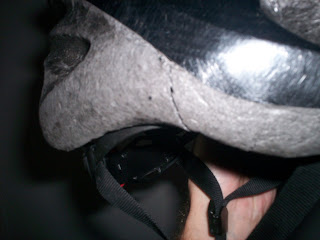
I hadn't been in a crash with a car before, and I hadn't been in a crash that wasn't at least partially my fault before, so both aspects have shaken me up a little. Also, I know that it happens every day, but it is still depressing to me that a motorist could hit someone like that and keep driving. I don't know what else to say about that, it's just disappointing.
A motorist and two pedestrians saw what happened and stopped to make sure I was okay. They confirmed the guy just hit me and took off.
I should have reported it, and I should have gotten contact info from the witnesses. I know and knew this, but I just wanted to get home and be done with it.
This morning I am a little sore, but nothing serious. My fork was not so lucky:

I haven't checked out the wheel and brake yet. Everything else looks okay.
I'm not zealous on the issue of helmets, but I'm glad I was wearing mine, as I smacked the right side of my head pretty hard on the street when I landed. Check out the crack it left in the foam:

I hadn't been in a crash with a car before, and I hadn't been in a crash that wasn't at least partially my fault before, so both aspects have shaken me up a little. Also, I know that it happens every day, but it is still depressing to me that a motorist could hit someone like that and keep driving. I don't know what else to say about that, it's just disappointing.
Tuesday, July 15, 2008
I Didn't Know That
Apparently delivery trucks are supposed to double park next to, rather than on top of, the bike lane. I don't think I've ever seen that. Also, since most (all?) bike lanes were added to existing streets, it would be my guess that the vast majority of one-way single-lane streets with bike lanes do not provide enough space for trucks to double park in the legal manner while still allowing traffic to pass by on the other side.
I also maintain that double parking in a bike lane is far less dangerous to cyclists than double parking on the other side of the street from a bike lane, forcing moving traffic into the bike lane to get by. Still not ideal, but the lesser of two evils if you want to permit double parking to any extent.
I also maintain that double parking in a bike lane is far less dangerous to cyclists than double parking on the other side of the street from a bike lane, forcing moving traffic into the bike lane to get by. Still not ideal, but the lesser of two evils if you want to permit double parking to any extent.
Thursday, June 5, 2008
Scootering Accident
Dude on Streetsblog hit a crack in the sidewalk and took a spill. Probably for the best, as he was in all likelihood a matter of minutes away from having his ass kicked:
I had been scootering along with my Taylor mini travel guitar strapped around my back, open air, troubadour style...Wanting to ride my new Xootr there, but not wanting to carry the case, I thought at the last minute to carry the guitar by itself, solely by its strap.Next time take your Segway and panpipes.
Tuesday, June 3, 2008
New Traffic Pattern at Brooklyn Bridge
Via mole333, the DOT is introducing new rules for the crash-heavy intersection of Adams and Tillary next week. My preferred route to the Manhattan Bridge, which is almost always how I get to the city by bicycle, goes across Adams and then left alongside the Brooklyn Bridge approach, and then a right on Sands to the Manhattan Bridge bike path.
The new pattern will mean I won't have to wait as long to cross Adams (and when I do, I will only have to follow one crosswalk signal instead of two). But on the other hand, all of the Brooklyn Bridge traffic that would cross my path at Adams I will now encounter either at Cadman West or at Jay and Sands, both intersections that are already difficult spots for asserting one's right-of-way over turning car traffic. (I do not know what crash statistics are like for those two places, but I suspect that there are fewer serious crashes there due almost entirely to there being less traffic overall.)
We shall see. As mole333 suggests, it's good that they are building a trial period into this change. As admittedly dangerous as the intersection is, there's no obvious quick fix that will make it better, so empirical experimentation like this is necessary.
The new pattern will mean I won't have to wait as long to cross Adams (and when I do, I will only have to follow one crosswalk signal instead of two). But on the other hand, all of the Brooklyn Bridge traffic that would cross my path at Adams I will now encounter either at Cadman West or at Jay and Sands, both intersections that are already difficult spots for asserting one's right-of-way over turning car traffic. (I do not know what crash statistics are like for those two places, but I suspect that there are fewer serious crashes there due almost entirely to there being less traffic overall.)
We shall see. As mole333 suggests, it's good that they are building a trial period into this change. As admittedly dangerous as the intersection is, there's no obvious quick fix that will make it better, so empirical experimentation like this is necessary.
Subscribe to:
Posts (Atom)