Atrios is right that urban residents' fear of disruption does not necessarily affect development plans in a positive direction. On the other hand, I don't think any "big project" can ever really deliver the kind of ideal urban vibrancy that attracts people to cities in the first place.
In the Gospel According to Jane is it writ, buildings close to one another should be of mixed construction age, not just designed for mixed use or income-level. Any big development is inherently going to fail at that and is going to have to succeed in every other aspect of urban planning just to break even.
But big projects are big profit, so developers are always going to push for them. Residents might be misguided in opposing any change to the status quo (a static neighborhood is not a healthy one) but in the case of confronting real big development projects, they will probably almost always end up minimizing the damage that these projects can wreak; limiting the height of a project isn't necessarily an ideal way of keeping an urban area healthy and vibrant, but if it's the only feasible means of limiting the project's scope then I think it's still justified.
Friday, May 30, 2008

Julie Klausner Kills It
Word. The most charitable thing you could say about someone who equates Pretty Woman and Legally Blonde is that at some point they may have seen one of the films. But they probably weren't paying much attention.
Thursday, May 29, 2008
Anticipa-Do List
My anticipatory to-do list program is complete. It's called Anticipa-Do List and basically works just as I described...you record whenever you clean your room or notice that it needs cleaning, and after a couple times it will remind you before it gets too bad:

Notifications are handled by setting up email reminders in Google Calendars. Here's an event that Anticipa-Do List has generated:

It's configured thus:

Notifications use a plugin system, so that part is flexible.
It's all C# and Windows and everything, so it's not like anyone I know could actually use it. But I'll post updates as my own life is revolutionized.
Update:
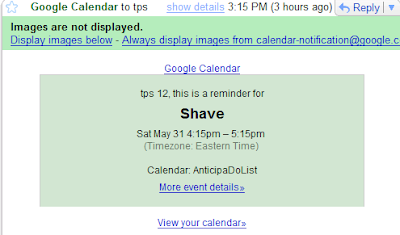

Notifications are handled by setting up email reminders in Google Calendars. Here's an event that Anticipa-Do List has generated:

It's configured thus:

Notifications use a plugin system, so that part is flexible.
It's all C# and Windows and everything, so it's not like anyone I know could actually use it. But I'll post updates as my own life is revolutionized.
Update:

In The Zone
I went to Manhattan's public Community Board 3 meeting Tuesday evening to see the DOT's proposal for bike lanes on Chrystie St. I'd never been to even one of my own CB's meetings, so it was at least informative in that sense.
I didn't stick around for the DOT presentation, but in the public comment portion of the meeting there was the one Transportation Alternatives guy talking in favor of the bike lanes in a way that suggested that they had really already been decided upon (basically, "hey, thanks for approving the new bike lanes") and nobody in opposition.
The meeting's real controversy was over a rezoning plan for the East Village. Coming late to the issue, I may be missing out on some history or nuance, but basically it seems that existing zoning regulations in the East Village limit floor area ratio, permitting the development of tall skinny towers as long as they leave enough empty space on the rest of a given lot (as was not considered undesirable in the early 60's when the regulations were enacted). Nobody in the neighborhood likes that idea now, so the new zoning would limit development with absolute height caps.
As far as I can tell, the controversy is not between residents and developers, but residents of the East Village (which composes only a subset of CB3's total area) and residents of Chinatown (the rest of it). (Both sides claim to include the Lower East Side, which, as far as I can tell, seems to straddle the downtown border of the rezoning region.)
Nobody wants their neighborhood taken over by giant towers, but the fewer that are permitted in the rezoned East Village, the argument goes, the more will consequently end up being built in the un-rezoned Chinatown; if the zoning stays as-is, then at least everyone shares the burden of new development, but even better would be a plan that protects everybody. It's a pretty straightforward supply-and-demand argument that's hard to dispute.
Of course, because of which neighborhood is getting rezoned and which isn't, there's also a racial angle that seems to be generating most of the hostility. And looking at the composition of the community board, it's easy to imagine that the process was, if not racist per se, at least somewhat less than complete in taking the opinions of all the affected parties into account.
I gather that people were arrested during the last public meeting, and at this one there was a sizable police presence and lots of shouting and catcalling as various community members and activists made their cases. (I held this blog post up for a day hoping that NY1 would have some video of screaming neighborhood activists and me cowering in the background, but I guess without the handcuffs coming out it's not newsworthy.)
At this point everyone seems pretty entrenched; there was one white guy who had been a supporter of the rezoning throughout the process (I guess it has taken four years to get to this point) but who wanted to broaden the area to include Chinatown. I noticed that he sat near and talked to a bunch of the Chinese activists, and was the only person I noticed who was widely applauded by both sides after he spoke.
A lot of the anti-rezoning (or more correctly, "anti-this-rezoning-plan-now") advocates also came across as more conciliatory, which makes sense, since the nature of their position is that they like the idea of rezoning...so much so that they want their own neighborhoods included in it. I guess the fear of those on the pro-rezoning side is that, in the time it would take to come up with a more inclusive plan, who knows how many new towers could go up in the region currently slated for rezoning. Especially as developers try to "beat the buzzer" and get projects approved before the zoning laws can change.
To which I guess I would say, you should have taken that into account when the process started. And perhaps it's true that in an ideal world, these concerns would have been raised by concerned Chinatown residents earlier in the process; but it's not as if they could not have been anticipated, and pushing rezoning through now, after concerns have been raised, resembles nothing more than "I've got mine, to hell with the rest of you."
A community board that looked out for residents first and property owners second (if at all) would do well to halt all new development until a plan rezoning the entire area could be designed. I don't expect that to happen. My guess is that getting the board's support for the current plan was made a whole lot easier when some developers thought they'd still have Chinatown to work with. But who knows!
I didn't stick around for the DOT presentation, but in the public comment portion of the meeting there was the one Transportation Alternatives guy talking in favor of the bike lanes in a way that suggested that they had really already been decided upon (basically, "hey, thanks for approving the new bike lanes") and nobody in opposition.
The meeting's real controversy was over a rezoning plan for the East Village. Coming late to the issue, I may be missing out on some history or nuance, but basically it seems that existing zoning regulations in the East Village limit floor area ratio, permitting the development of tall skinny towers as long as they leave enough empty space on the rest of a given lot (as was not considered undesirable in the early 60's when the regulations were enacted). Nobody in the neighborhood likes that idea now, so the new zoning would limit development with absolute height caps.
As far as I can tell, the controversy is not between residents and developers, but residents of the East Village (which composes only a subset of CB3's total area) and residents of Chinatown (the rest of it). (Both sides claim to include the Lower East Side, which, as far as I can tell, seems to straddle the downtown border of the rezoning region.)
Nobody wants their neighborhood taken over by giant towers, but the fewer that are permitted in the rezoned East Village, the argument goes, the more will consequently end up being built in the un-rezoned Chinatown; if the zoning stays as-is, then at least everyone shares the burden of new development, but even better would be a plan that protects everybody. It's a pretty straightforward supply-and-demand argument that's hard to dispute.
Of course, because of which neighborhood is getting rezoned and which isn't, there's also a racial angle that seems to be generating most of the hostility. And looking at the composition of the community board, it's easy to imagine that the process was, if not racist per se, at least somewhat less than complete in taking the opinions of all the affected parties into account.
I gather that people were arrested during the last public meeting, and at this one there was a sizable police presence and lots of shouting and catcalling as various community members and activists made their cases. (I held this blog post up for a day hoping that NY1 would have some video of screaming neighborhood activists and me cowering in the background, but I guess without the handcuffs coming out it's not newsworthy.)
At this point everyone seems pretty entrenched; there was one white guy who had been a supporter of the rezoning throughout the process (I guess it has taken four years to get to this point) but who wanted to broaden the area to include Chinatown. I noticed that he sat near and talked to a bunch of the Chinese activists, and was the only person I noticed who was widely applauded by both sides after he spoke.
A lot of the anti-rezoning (or more correctly, "anti-this-rezoning-plan-now") advocates also came across as more conciliatory, which makes sense, since the nature of their position is that they like the idea of rezoning...so much so that they want their own neighborhoods included in it. I guess the fear of those on the pro-rezoning side is that, in the time it would take to come up with a more inclusive plan, who knows how many new towers could go up in the region currently slated for rezoning. Especially as developers try to "beat the buzzer" and get projects approved before the zoning laws can change.
To which I guess I would say, you should have taken that into account when the process started. And perhaps it's true that in an ideal world, these concerns would have been raised by concerned Chinatown residents earlier in the process; but it's not as if they could not have been anticipated, and pushing rezoning through now, after concerns have been raised, resembles nothing more than "I've got mine, to hell with the rest of you."
A community board that looked out for residents first and property owners second (if at all) would do well to halt all new development until a plan rezoning the entire area could be designed. I don't expect that to happen. My guess is that getting the board's support for the current plan was made a whole lot easier when some developers thought they'd still have Chinatown to work with. But who knows!
Wednesday, May 28, 2008
Thick Erections
By happy coincidence, I was in the process of reading The Corrections just as Harper's contributing editor Wyatt Mason posted his three-part account of an event with Jonathan Franzen discussing his novel with critic James Wood.
The first part recounts their conversation on the state of the novel and the extent to which Franzen had succeeded in balancing challenging fiction with readable narratives, concluding with Mason asking about the role criticism plays in Franzen's work as a novelist. The second begins with Franzen's response that it does play a significant role, and then Mason follows up by wondering why more writers of fiction don't engage with critics directly. (Relevant footnotes here to Wood's review of The Corrections and Mason's review of Wood's first novel, The Book Against God.) And the third part addresses the idea that critics do not engage with contemporary fiction, leading to the introduction of Mason's essay arguing that there is plenty of intelligent criticism being written. Which I gather is a running theme of Mason's.
Anyway. I enjoyed it all. With the exception of the Book Against God review which I mostly skimmed until I get a chance to read the book. No spoilerz.
The first part recounts their conversation on the state of the novel and the extent to which Franzen had succeeded in balancing challenging fiction with readable narratives, concluding with Mason asking about the role criticism plays in Franzen's work as a novelist. The second begins with Franzen's response that it does play a significant role, and then Mason follows up by wondering why more writers of fiction don't engage with critics directly. (Relevant footnotes here to Wood's review of The Corrections and Mason's review of Wood's first novel, The Book Against God.) And the third part addresses the idea that critics do not engage with contemporary fiction, leading to the introduction of Mason's essay arguing that there is plenty of intelligent criticism being written. Which I gather is a running theme of Mason's.
Anyway. I enjoyed it all. With the exception of the Book Against God review which I mostly skimmed until I get a chance to read the book. No spoilerz.
Cats in 3D
The other day I noticed that both cats were on my bed sleeping even more deeply than usual. I managed to get anaglyph photos of each of them. Lucy is curled up all sweetly, and the Colonel is in fine form with her arms splayed out. Very cute.
Excellent
Bike Snob NYC's latest quiz features the tall bike that's chained up by the elementary school where I vote.
Tuesday, May 27, 2008
Stimolous
Andrew and I discussed the stimulus checks, and the political motivation thereof, in our last/next/currently in production podcast. More grist for the cynical ploy to leave taxpayers feeling personally indebted to George W. Bush mill:


Uh, racist?
This word newsletter I read had an interesting pick for this week's "weird word": jiggery-pokery.
Thursday, May 22, 2008
You Can Have Any Economy You Want, As Long As It's Capitalism
Cam doesn't like Naomi Klein's criticisms of capitalism, but his criticisms don't stand up.
His analogy of today's China to the Detroit of yesteryear (and post-NAFTA Mexico, for heaven's sake) is telling in its aptness. The old US auto industry was the very picture of thuggish capitalism, working in concert with the state to commoditize labor and squelch potential competition. No, "[t]he police state is not necessary for the efficient delivery of capitalism" of this sort, but it certainly does help, as the fascist Henry Ford certainly recognized.
It is customary, when extolling the virtues of classical liberalism (which actually is "predicated on free markets and economic liberty"), to overlook such gross capitalistic excesses as are represented by Fordism and contemporary China. To hold them up as exemplars is mystifying.
To be sure, Klein is mistaken in her article, but her mistake is in the same vein as Cam's: "free markets and free people" may well "go hand in hand," but neither one has much to do with capitalism.
His analogy of today's China to the Detroit of yesteryear (and post-NAFTA Mexico, for heaven's sake) is telling in its aptness. The old US auto industry was the very picture of thuggish capitalism, working in concert with the state to commoditize labor and squelch potential competition. No, "[t]he police state is not necessary for the efficient delivery of capitalism" of this sort, but it certainly does help, as the fascist Henry Ford certainly recognized.
It is customary, when extolling the virtues of classical liberalism (which actually is "predicated on free markets and economic liberty"), to overlook such gross capitalistic excesses as are represented by Fordism and contemporary China. To hold them up as exemplars is mystifying.
To be sure, Klein is mistaken in her article, but her mistake is in the same vein as Cam's: "free markets and free people" may well "go hand in hand," but neither one has much to do with capitalism.
Anticipatory To-Do List
A few weeks ago, friend Dmitry told me about this Wired story on a crazy Polish guy who invented this software that helped you remember things. Basically you tell it what you want to remember and then every now and then it checks whether you've forgotten stuff and based on how long it takes you to forget things, it learns what the optimal moment is to send you reminders so you will remember stuff forever.
So that exists. But something I realized today—as I noticed that my workspace and bedroom has once again become buried under daunting piles of sweaters, eviscerated cat toys, and junk mail—is that a similar program could be used to manage periodically recurring chores before they get overwhelmingly out of control.
The idea is that for each task—cleaning the toilet, say—you'd first get the program moving by noting down either "I did it" or "I noticed it needed doing" on the appropriate date. (If you happen to remember both—"I saw on Thursday that it looked pretty grody, and then on Sunday I got around to cleaning it"—then all the better, but recording just one or the other is enough to get started.)
From then on, every time you either a) do one of your tasks or b) notice that it needs to get done again, you record it in the program. And after a couple repetitions, the software will start to be able to predict that your toilet is ready for a cleaning around every sixteen days, and that it's usually three or four days before you get around to doing it. And so then when twelve days have gone by since the last cleaning, and you haven't even thought about doing it again, the program can email you and be like "hey, clean the toilet before it gets too nasty."
And it will constantly be feeding back on itself, so that if you do your tasks right away when it tells you to, it will give you some more time before the next reminder; but if you procrastinate, and it has to nag you with emails for a week, then next time it will take that into account and notify you well in advance.
The software could optionally randomize its notifications slightly, so that you won't be expecting them at a specific time and thus more easily ignore them. And maybe it could notice if, for example, the fish tank and the bathtub were about to be in need of cleaning on the same day it would be time to mow the lawn and oil your bike chain, and space those tasks out over a couple days so you wouldn't get overwhelmed by a sudden deluge.
It would not work for tasks, like feeding the dog or paying your taxes, that (hopefully!) get done on an externally imposed schedule; regular calendars and to-do lists, if not simple force of habit, can deal with those easily enough. And it would not work for people who prefer to leave their messes until a biweekly "big clean," or who like to set aside one day a month to sort out all their bills.
It seems like a simple enough program to write, and though I couldn't find anything like it, I may have just been searching for the wrong terms. I did find that the Boy Scouts have a merit badge for time management. Which is hilarious.
So I might take a crack at a quick proof of concept, just to see if I actually use it. And to give me something to do while I'm avoiding sweeping the stairs, natch.
So that exists. But something I realized today—as I noticed that my workspace and bedroom has once again become buried under daunting piles of sweaters, eviscerated cat toys, and junk mail—is that a similar program could be used to manage periodically recurring chores before they get overwhelmingly out of control.
The idea is that for each task—cleaning the toilet, say—you'd first get the program moving by noting down either "I did it" or "I noticed it needed doing" on the appropriate date. (If you happen to remember both—"I saw on Thursday that it looked pretty grody, and then on Sunday I got around to cleaning it"—then all the better, but recording just one or the other is enough to get started.)
From then on, every time you either a) do one of your tasks or b) notice that it needs to get done again, you record it in the program. And after a couple repetitions, the software will start to be able to predict that your toilet is ready for a cleaning around every sixteen days, and that it's usually three or four days before you get around to doing it. And so then when twelve days have gone by since the last cleaning, and you haven't even thought about doing it again, the program can email you and be like "hey, clean the toilet before it gets too nasty."
And it will constantly be feeding back on itself, so that if you do your tasks right away when it tells you to, it will give you some more time before the next reminder; but if you procrastinate, and it has to nag you with emails for a week, then next time it will take that into account and notify you well in advance.
The software could optionally randomize its notifications slightly, so that you won't be expecting them at a specific time and thus more easily ignore them. And maybe it could notice if, for example, the fish tank and the bathtub were about to be in need of cleaning on the same day it would be time to mow the lawn and oil your bike chain, and space those tasks out over a couple days so you wouldn't get overwhelmed by a sudden deluge.
It would not work for tasks, like feeding the dog or paying your taxes, that (hopefully!) get done on an externally imposed schedule; regular calendars and to-do lists, if not simple force of habit, can deal with those easily enough. And it would not work for people who prefer to leave their messes until a biweekly "big clean," or who like to set aside one day a month to sort out all their bills.
It seems like a simple enough program to write, and though I couldn't find anything like it, I may have just been searching for the wrong terms. I did find that the Boy Scouts have a merit badge for time management. Which is hilarious.
So I might take a crack at a quick proof of concept, just to see if I actually use it. And to give me something to do while I'm avoiding sweeping the stairs, natch.
Wednesday, May 21, 2008
Check Cashing
I enjoyed Dallas and Rafi's new video on check cashing places. Also, part of it is shot right down the street!
Tuesday, May 20, 2008
Not That Surprising
A big part of New York "progressivism" consisting of opposition to the corrupt local party establishment and entrenched influence in Albany, it's not really all that surprising that the DNC has chosen to credential a more accommodating group of Democratic bloggers for the convention. Endorsing another primary candidate over the state's junior US Senator, not exactly going to curry favor with the proverbial powers that be.
Which isn't to knock The Daily Gotham crew, none of whom I imagine would be particularly insulted were they to be described as being more dedicated to liberal and progressive principles than to the political goals of the Democratic Party per se. But the party itself's greater interest in the latter is hardly a shock.
(Not familiar with the political environment in Jersey, but I would imagine it's much the same there.)
Which isn't to knock The Daily Gotham crew, none of whom I imagine would be particularly insulted were they to be described as being more dedicated to liberal and progressive principles than to the political goals of the Democratic Party per se. But the party itself's greater interest in the latter is hardly a shock.
(Not familiar with the political environment in Jersey, but I would imagine it's much the same there.)
Monday, May 19, 2008
The Red-Green Show
I was thinking about color-blindness the other day as I was trying to wrap my head around some coordinate issues I was having in Blender and noted how much even more confusing it would all be if I couldn't tell the color-coded axes apart on the screen.
For some reason the importance of not relying on red/green distinctions is like the only thing that stuck with me from the user interface design course Andrew and I took in college. Hullabaloo's Tristero has a post up on the problems that can arise from overreliance on color distinctions in diagrams.
There's also this excerpt of Oliver Sacks' that has some really interesting analogies between absolute versus relative pitch and different experiences of color vision, including disorders.
For some reason the importance of not relying on red/green distinctions is like the only thing that stuck with me from the user interface design course Andrew and I took in college. Hullabaloo's Tristero has a post up on the problems that can arise from overreliance on color distinctions in diagrams.
There's also this excerpt of Oliver Sacks' that has some really interesting analogies between absolute versus relative pitch and different experiences of color vision, including disorders.
Liberdeez Nutz
In the course of arguing in favor of early schooling, Kathy G. quotes someone from Cato writing in The New Republic:
Seriously, I fully expect this Brink Lindsey to be run out of town on a rail for suggesting that the government might be justified in educating children, a clear violation of parents' property rights.
[M]e and my fellow libertarians...insist on the central importance of individual responsibility for the healthy functioning of a free society. Yet, by the time people become legally responsible adults, circumstances not of their own choosing—namely, how they were raised and whom they grew up with—may have prevented them from ever developing the capacities they need to thrive and flourish. Which raises the possibility that government intervention to improve those circumstances could actually expand the scope of individual autonomy.That strikes me as a pretty major concession coming from a right-libertarian. My impression is that the coherence of a lot of Cato's positions (e.g., against the estate tax) rests on a rather narrow interpretation of "liberty" where the only potential actor against liberty is the state, via the twin vectors of capital gains taxes and minimum sentences for marijuana possession. Once you've admitted that "individual autonomy" can be impeded by one's childhood environment, doesn't that open the door to the possibility that polluted drinking water, a racist police force, or an exploitative employer or landlord could have a similarly negative effect?
Seriously, I fully expect this Brink Lindsey to be run out of town on a rail for suggesting that the government might be justified in educating children, a clear violation of parents' property rights.
Iron Man Not So Critical
Ezra Klein is right on the money in labeling Iron Man "less [criticism] than absolution" in its commentary on the evils of US foreign policy. It's the old Captain Planet dilemma: in order to convey the seriousness of hurting the environment or arming terrorists, you portray an evil supervillain doing those things; but then since the people in the real world who do the most environmental damage and prop up the most brutal dictators are not mustachioed villains, but just regular politicians and businesspeople doing what they do in a fairly aboveboard (if not extremely well publicized) manner, they're let off the hook.
The (only slightly less comic book-y) Lord of War sort of got at the underlying issue a little better. Though (spoiler warning) if I recall, even in that film it was government figures working in the shadows behind the scenes who were driving the US's role as a state sponsor of terrorism. It's a little more critical of a portrayal, since at least the "bad guys" are clearly acting out of political rather than financial motivations, but there's still the idea that surely nobody could get away with such wickedness were it out in the open, whereas in reality they do even when it is.
The (only slightly less comic book-y) Lord of War sort of got at the underlying issue a little better. Though (spoiler warning) if I recall, even in that film it was government figures working in the shadows behind the scenes who were driving the US's role as a state sponsor of terrorism. It's a little more critical of a portrayal, since at least the "bad guys" are clearly acting out of political rather than financial motivations, but there's still the idea that surely nobody could get away with such wickedness were it out in the open, whereas in reality they do even when it is.
New Podcast Episode
Andrew has posted a second round of applause. I swear I can hear myself chewing throughout the first half, so next time I'm going to forego the snacks. I also say "like" too much. There are some funny moments in the second half, I think.
Friday, May 16, 2008
Nicely Done
I've been following the story of Phyllis Schlafly getting an honorary degree from Washington U. Tasteful protest, executed well, it sounds like. Good for them.
Clean as a Hippie!
Cam linked to a blog dedicated to "unbranding" your home. Totally my kind of thing, but I'm skeptical about the natural cleaning tips. In particular, the idea that vinegar and baking soda combine to make a more effective cleaning product than either one alone, and that you can "see it working" as it foams up. What you can see is the mixture turning into water and carbon dioxide, but maybe carbon dioxide is really good for cleaning. Anyway, I haven't tried it, so I guess I should reserve judgment.
Subscribe to:
Posts (Atom)