Someone somewhere linked to a blog that linked to a blog called Token Minorities, which has some recent posts looking at some of the controversy stirred up last year by the the Resident Evil 5 video game trailers. The game appears to feature a white hero mowing down hordes of zombified black people.
What I find interesting about this is that the zombie genre has always dealt with the fear of the mindless avenging horde. The classic point almost always being the danger that said fear could lead us to commit or condone horrific atrocities, or that society's injustices could blind us to the real threat.
My feeling is that, even if a given zombie story doesn't explicitly portray racial conflict, the very invocation of the mindless avenging horde archetype resonates along those lines when situated in a societal context that includes a strong undercurrent of racial fear. Stories about supernatural mindless hordes tap into actual fears, so in a way all something like Resident Evil is doing (both with this iteration and in the last installment, in which I gather players had to kill waves of marauding Mexicans) is making that culturally-imposed subtext explicit.
Which isn't to excuse the racism. Even when done intentionally (a la Night-Wight) to prompt a meta-conversation about subtext, the racist content is still there and still real. Hopefully the Resident Evil creators will do the mature thing in response to the public outcry, and change the problematic content before the game is released. But it's also worthwhile to take the opportunity to reflect on the feelings that are triggered by the whole series, and by zombie narratives in general.
Monday, April 28, 2008

Some Bloggers Are Wankers
I don't read GrandGood, but I greatly enjoyed R.H.S.'s two posts responding to some sort of whining about "racism" directed at white hip-hop bloggers. R.H.S. pegs the motivating sentiment as discomfort with black nationalist type views.
And who can blame him, really...black nationalism is inherently discomforting to white people, and that's sort of the whole point. But responding with the tired we-should-be-talking-about-class-rather-than-race/blacks-can-be-racist-too lines (with a bonus dose of why-can't-I-use-the-N-word) is completely out of order.
Especially when the comment that set him off (along the lines of "you should blog about something you're more qualified to comment on, like banking") is a) far less offensive than what you can find in any randomly-selected Byron Crawford post, and b) actually pretty funny.
And who can blame him, really...black nationalism is inherently discomforting to white people, and that's sort of the whole point. But responding with the tired we-should-be-talking-about-class-rather-than-race/blacks-can-be-racist-too lines (with a bonus dose of why-can't-I-use-the-N-word) is completely out of order.
Especially when the comment that set him off (along the lines of "you should blog about something you're more qualified to comment on, like banking") is a) far less offensive than what you can find in any randomly-selected Byron Crawford post, and b) actually pretty funny.
Friday, April 25, 2008
Oops, Ding Dong
Wish I had known about this latest Amanda Marcotte controversy going into last night's reading. Not that there were any fireworks or anything, but it would have added an interesting subtext. I am sure I'm not the first to find it ironic which "politically inhospitable environment" Amanda has found herself in.
Thursday, April 24, 2008
To What?!?
The other day while I was lying in bed either falling asleep or waking up, I had the flash of insight that the phrase "to wit" means "to make a witticism." That is, one should use it only as a lead-in to a punchline: "The vet informed me that my prize-winning ewe was doomed to a life of incontinence. To wit: my sheep had lost her peep."
I looked it up today, and it turns out I'm wrong: "to wit" just means "namely."
I looked it up today, and it turns out I'm wrong: "to wit" just means "namely."
Wednesday, April 23, 2008
No, You Save Us
Matt Yglesias is "getting really tired of [primary season]." Well, I'm sure he's not alone. It is possible to ignore the day-to-day bickering, the debates, the new polls that are always coming out. He should try it. As a member of the DC media, he might even by doing so make it a little less tiring for everyone else.
Tuesday, April 22, 2008
Monday, April 21, 2008
Ron Darling Catches Himself
Reflecting on Japanese players in the US following a Kosuke Fukudome at-bat in the fourth:
When I played, nobody thought Japanese players would ever be able to compete in the US, because they just weren't as big, couldn't throw as hard. But now today, with their level of schooling—Pause, no doubt while Ron is berated by his producer via headset.
—and with new training techniques, they're now just as big as some American players.Whew, nice save.
Friday, April 18, 2008
Too Perfect to Check
This is sort of, uh, hard to swallow, but it sure does draw the employer/employee relationship in pretty stark terms. Yes, in all likelihood, your management will subject you to whatever it thinks it can get away with under the Geneva Conventions. It wouldn't be management otherwise.
Thursday, April 17, 2008
Tuesday, April 15, 2008
Deference
I read the responses to the recent Feministe Feedback question on Being a Feminist Boyfriend with a lot of interest, and I was surprised that Amanda at Pandagon took issue with the first comment, which suggested that "deference is a privileged person's best friend." I had actually thought that a really succinct way of putting my thoughts on the issue.
It turns out I was just mistaken on the definition of "deference." There are a couple different ones, but they all seem to hinge on being "courteous and respectful" in "submission," or "yielding," to another. Sounds a lot like chivalry, and I agree, totally inappropriate.
But I think there is a related attitude, on the part of anyone in a discussion with someone over whom they enjoy privilege, that it is important to have. And that's to never assume that "awareness" of the issue at hand can ever substitute for that issue as seen by someone who must experience it first-hand.
The flawed behavior the attitude addresses can manifest in two ways, dismissal and self-righteousness. The dismissive version is basically, "look, I know all about feminism, and you're overreacting." And the self-righteous version is some variation on "I know all about feminism and you're being a bad feminist." In either case, the privileged person is claiming that their theoretical knowledge of oppression should trump another's actual experience of that oppression.
(I'm sticking with gender and feminism here since that's the discussion that brought it up, but the same dynamic obviously applies to any sort of societal oppression.)
By dint of the very privilege that's at issue, the privileged person's voice is going to have more weight behind it, and so it is even more vital that the privileged person takes other voices seriously. Which is what I would have wanted to call "deference," since one "defers" to the relevant experience of another. But it's not really "deference" because you're not doing it out of "respect and courtesy," but because they are in a position where they are more likely to know what the fuck they are talking about.
It's like when you're trying to squeeze into a tight parking space and your friend hops out to help direct you in from the sidewalk. You don't follow their instructions out of "respect" or "courtesy," but because they are positioned such that their perspective is more likely correct. No matter how sure you are that you're about to scrape the car on your left, if they assure you that you have more room, then you trust them. Unless you have reason to think they're trying to make you crunch your fender, you have to acknowledge that they're in the best place to judge the relevant distances.
As someone who has read a little in feminism, and who tends to didacticism in all things (but who has lived not one second as a woman under patriarchy), my tendency is to err on the "self-righteous" side (though I have certainly had my share of dismissive moments as well). But obviously, whatever little use I may be lies in being able to speak about oppression to other privileged people, from a shared position of privilege. Discussion with others should not primarily be about making myself feel good about my "awareness"; rather, it is a good time to listen, and should be valued as the learning opportunity it is.
It turns out I was just mistaken on the definition of "deference." There are a couple different ones, but they all seem to hinge on being "courteous and respectful" in "submission," or "yielding," to another. Sounds a lot like chivalry, and I agree, totally inappropriate.
But I think there is a related attitude, on the part of anyone in a discussion with someone over whom they enjoy privilege, that it is important to have. And that's to never assume that "awareness" of the issue at hand can ever substitute for that issue as seen by someone who must experience it first-hand.
The flawed behavior the attitude addresses can manifest in two ways, dismissal and self-righteousness. The dismissive version is basically, "look, I know all about feminism, and you're overreacting." And the self-righteous version is some variation on "I know all about feminism and you're being a bad feminist." In either case, the privileged person is claiming that their theoretical knowledge of oppression should trump another's actual experience of that oppression.
(I'm sticking with gender and feminism here since that's the discussion that brought it up, but the same dynamic obviously applies to any sort of societal oppression.)
By dint of the very privilege that's at issue, the privileged person's voice is going to have more weight behind it, and so it is even more vital that the privileged person takes other voices seriously. Which is what I would have wanted to call "deference," since one "defers" to the relevant experience of another. But it's not really "deference" because you're not doing it out of "respect and courtesy," but because they are in a position where they are more likely to know what the fuck they are talking about.
It's like when you're trying to squeeze into a tight parking space and your friend hops out to help direct you in from the sidewalk. You don't follow their instructions out of "respect" or "courtesy," but because they are positioned such that their perspective is more likely correct. No matter how sure you are that you're about to scrape the car on your left, if they assure you that you have more room, then you trust them. Unless you have reason to think they're trying to make you crunch your fender, you have to acknowledge that they're in the best place to judge the relevant distances.
As someone who has read a little in feminism, and who tends to didacticism in all things (but who has lived not one second as a woman under patriarchy), my tendency is to err on the "self-righteous" side (though I have certainly had my share of dismissive moments as well). But obviously, whatever little use I may be lies in being able to speak about oppression to other privileged people, from a shared position of privilege. Discussion with others should not primarily be about making myself feel good about my "awareness"; rather, it is a good time to listen, and should be valued as the learning opportunity it is.
Monday, April 14, 2008
Friday, April 11, 2008
Stephen King, Awesome at Any Age
A blog comment linking to a post about series with crappy endings led me to refresh myself on the plots of the Narnia books on Wikipedia (the next movie comes out in May!). I totally didn't remember how (spoiler alert) it all ended with Aslan talking about how in England he was called "Jesus." And actually I was retarded enough when I read those books that it probably still went over my head.
Anyway, somewhere I saw a mention of Stephen King's Dark Tower series, and I was all "oh yeah! I remember those!" I think when I read them there were only three, and I was so anxious about when the next one would come out and how it would all end, and what if Stephen King died in his mid-40's unable to complete the saga? But I guess I forgot about reading them, though I still remember (spoiler alert) the gunslinger fighting lobsters on the beach and learning about tunafish.
And it turns out (spoiler alert) Stephen King still isn't dead! And in fact, he actually finished the Dark Tower series, though I gather it was pretty disappointing in the end and at some point someone needed to obtain "the Pink Grapefruit." And so I've been reading all about Randall Flagg and about Stephen King's other books, and I came across this:
I just want to propose that anyone who comes up with that is awesome. A tip of my hat to you, Stephen King, or to whoever hacked all the Stephen King articles on Wikipedia and made them hilarious.
Anyway, somewhere I saw a mention of Stephen King's Dark Tower series, and I was all "oh yeah! I remember those!" I think when I read them there were only three, and I was so anxious about when the next one would come out and how it would all end, and what if Stephen King died in his mid-40's unable to complete the saga? But I guess I forgot about reading them, though I still remember (spoiler alert) the gunslinger fighting lobsters on the beach and learning about tunafish.
And it turns out (spoiler alert) Stephen King still isn't dead! And in fact, he actually finished the Dark Tower series, though I gather it was pretty disappointing in the end and at some point someone needed to obtain "the Pink Grapefruit." And so I've been reading all about Randall Flagg and about Stephen King's other books, and I came across this:
Roland's wine is poisoned, Roland drinks it and dies in three days, Roland's youngest son watches in horror as he drinks the poison. Peter is blamed for it, and is locked up in the enormous tower...Peter has made two requests for things he wants in his cell: his mother's dollhouse, and a napkin with every meal. Peter takes 5 threads from each napkin and with the help of a working loom from the dollhouse weaves them into a rope.
I just want to propose that anyone who comes up with that is awesome. A tip of my hat to you, Stephen King, or to whoever hacked all the Stephen King articles on Wikipedia and made them hilarious.
Wednesday, April 9, 2008
Weird Observation
Sadie from Itty Bitty Titty Committee has the exact same accent as Carcetti from The Wire.
Also, one of the McPoyle brothers is the plastic surgeon.
Also also, I'm sure I wasn't the only Mets fan who watched a BitTorrent of Itty Bitty Titty Committee because his roommate was watching Simpsons reruns.
Also, one of the McPoyle brothers is the plastic surgeon.
Also also, I'm sure I wasn't the only Mets fan who watched a BitTorrent of Itty Bitty Titty Committee because his roommate was watching Simpsons reruns.
Nerd Party
I wrote this C# class for reading INI files on my own time and I think it's cool so I'm posting it up. It uses reflection to populate the fields and properties in a class with values from an INI file.
If you want to read a Windows INI file that looks like this,
There are a lot of INI access utility classes out there (thanks to Microsoft not providing any in the Framework), but all the ones I saw used things like dictionaries to look up values by string. I think the reflection approach makes for neater client code.
Potential improvements include the ability to specify alternate names for member data, allowing you to access key or section names that are not valid C# identifiers; and the ability to write out changes to the member data to the INI file.
If you want to read a Windows INI file that looks like this,
;test.inithen you just make a subclass like this,
[Shape]
Width=100
[Name]
First=John
Last=Williams ,
class TestIni : IniFileand then you can use it like this:
{
public TestIni() : base("test.ini") { }
public class ShapeSection
{
public int Width = 10;
}
public readonly ShapeSection Shape = new ShapeSection();
public class NameSection
{
public string First = "";
public string Last = "";
}
public readonly NameSection Name = new NameSection();
} ,
TestIni ini = new TestIni();It's cool because the structure of the subclass mirrors the structure of the INI file it represents, with a member class for each section containing a field or property for each key.
Console.WriteLine("{0}, {1}", ini.Shape.Width, ini.Name.First); .
There are a lot of INI access utility classes out there (thanks to Microsoft not providing any in the Framework), but all the ones I saw used things like dictionaries to look up values by string. I think the reflection approach makes for neater client code.
Potential improvements include the ability to specify alternate names for member data, allowing you to access key or section names that are not valid C# identifiers; and the ability to write out changes to the member data to the INI file.
Tuesday, April 8, 2008
Developers and Other Scum
Dallas Penn has some amazing photos up showing neighborhoods eaten up by real estate development. As he points out in the text, developers are yet another group who have an interest in letting drugs and crime tear apart communities.
It should be illegal to own residential property that you do not yourself live in; commercial property out of which you do not yourself run a business; or agricultural property which you do not yourself farm. Existing rentals would be collectivized and ownership handed over to current residents, employees, and farm workers.
It should be illegal to own residential property that you do not yourself live in; commercial property out of which you do not yourself run a business; or agricultural property which you do not yourself farm. Existing rentals would be collectivized and ownership handed over to current residents, employees, and farm workers.
Who's Gonna Train Me Cats?
Some dog training book I read (Cesar Millan's?) pointed out that in any movie that features a bunch of animals together in a room not chasing each other (the example given was Dr. Dolittle), each of those animals has a trainer standing just off-set, keeping them on task with their positive energy (this is what makes me think it was Cesar's).
This caused me to realize that, duh, you see cats in movies, and therefore they must be trainable, regardless of what people say. I know people train cats to use toilets, after all, so getting them to respond to commands can't be impossible. And indeed, I have found some information on training cats.
We started Monday with "sit." I've been introducing the Colonel to the vocabulary for "kiss," "lap," and "tummy," but not trying to get her to do any of it on command yet, and of course Lucy already fetches on her own. But I did get them each to "come" and "sit" for me a couple times.
This caused me to realize that, duh, you see cats in movies, and therefore they must be trainable, regardless of what people say. I know people train cats to use toilets, after all, so getting them to respond to commands can't be impossible. And indeed, I have found some information on training cats.
We started Monday with "sit." I've been introducing the Colonel to the vocabulary for "kiss," "lap," and "tummy," but not trying to get her to do any of it on command yet, and of course Lucy already fetches on her own. But I did get them each to "come" and "sit" for me a couple times.
Monday, April 7, 2008
Fan Pro Tips
While I was trying to find the link for my Sex and the City fanfic the other day in preparation for reading it at Lindsay and Gabe's show, I came across this page of advice for aspiring fanfictionists. The bullet list regarding sex scenes is especially amazing, and two or three of the items were absolutely essential to my piece.
Inside, outside, Holiday Inn
Sarah and I were going to look at an apartment this weekend (we ended up not even getting to see it because someone else took it before we got the chance) that was an "eco-renovated" brownstone, everything redone with sustainable materials and designed for efficiency and conservation. E.g., they had the toilets common throughout the rest of the developed world where you get one little flusher for pee and a bigger flusher for poo.
I was pretty psyched about the possibility of living someplace like that. I find something satisfying about efficiency. Must be my Germanic ancestry. With my current landlord, getting storm windows to replace the paper-thin panes in the living room was a huge coup, and we lobbied for months trying to get him to fix a leak in the bathtub tap...it was wasting gallons and gallons of potable water, but even though he paid the water bill, it wasn't costing him enough to justify hiring a plumber.
And of course, he was right; even if we had succeeded in getting the leak fixed, there's doubtless a dozen other leaky taps in the building and a hundred among the rest of the buildings on the block. If it's not worth fixing to him then it's not worth fixing to anybody, and taking care of our tiny leak would literally amount to a drop in the ocean.
A small minority of building owners, like the landlord of the building we wanted to look at this weekend, are sufficiently opposed to wasting water on principle that they would keep things leak-free, but that's ultimately not a rational decision based on sound economics. The question is, how do you change the system so that the people who are deciding things rationally make the choice that we want, which is to prevent so much wasted water?
In economics terms, the rational decision to let water go to waste is the result of an externality: wasted drinking water has a certain cost to society that is not fully represented in the dollar cost of tap water to the person paying the bill. This is why communities experiencing drought need to enact ordinances against watering your lawn: if water prices in those communities accurately reflected the marginal cost of water to the community as water became more scarce, then pretty much everyone would decide to stop watering their lawn all on their own; but since water, as a basic requirement for living, is subsidized, there's no price signal to respond people and you have to tell them explicitly "don't do that, we're running out of water."
Dealing with externalities wisely is like driving a boat or building a bridge: if you can set things up so the prevailing winds or gravity do a lot of the work, then there's a lot less for you to handle yourself with paddles or poured concrete. If you can manipulate prices so that the market does the heavy lifting to conserve precious resources or whatever, then there's a lot less left over to clean up with regulation.
What the case of water-wasting tap leaks made me realize is that the easy way of internalizing externalities in the case of conservation of resources—imposing a "Pigovian tax" somewhere along the line—sort of falls apart when you're talking about a resource that you want everyone to have essentially unhindered access to as a matter of rights.
It's simple enough to raise water prices to the point where most landlords will start looking after their plumbing. But as soon as water is priced anywhere above a nominal level then you'll have people going unwashed (the masses will basically go unwashed at the drop of a hat), letting their gardens dry out, and drinking inadequate water to stay healthy. And slumlords will just let their taps leak away and make their tenants responsible for the water bill. Basically, by trying to internalize one externality you end up creating another.
Which is just too bad.
I was pretty psyched about the possibility of living someplace like that. I find something satisfying about efficiency. Must be my Germanic ancestry. With my current landlord, getting storm windows to replace the paper-thin panes in the living room was a huge coup, and we lobbied for months trying to get him to fix a leak in the bathtub tap...it was wasting gallons and gallons of potable water, but even though he paid the water bill, it wasn't costing him enough to justify hiring a plumber.
And of course, he was right; even if we had succeeded in getting the leak fixed, there's doubtless a dozen other leaky taps in the building and a hundred among the rest of the buildings on the block. If it's not worth fixing to him then it's not worth fixing to anybody, and taking care of our tiny leak would literally amount to a drop in the ocean.
A small minority of building owners, like the landlord of the building we wanted to look at this weekend, are sufficiently opposed to wasting water on principle that they would keep things leak-free, but that's ultimately not a rational decision based on sound economics. The question is, how do you change the system so that the people who are deciding things rationally make the choice that we want, which is to prevent so much wasted water?
In economics terms, the rational decision to let water go to waste is the result of an externality: wasted drinking water has a certain cost to society that is not fully represented in the dollar cost of tap water to the person paying the bill. This is why communities experiencing drought need to enact ordinances against watering your lawn: if water prices in those communities accurately reflected the marginal cost of water to the community as water became more scarce, then pretty much everyone would decide to stop watering their lawn all on their own; but since water, as a basic requirement for living, is subsidized, there's no price signal to respond people and you have to tell them explicitly "don't do that, we're running out of water."
Dealing with externalities wisely is like driving a boat or building a bridge: if you can set things up so the prevailing winds or gravity do a lot of the work, then there's a lot less for you to handle yourself with paddles or poured concrete. If you can manipulate prices so that the market does the heavy lifting to conserve precious resources or whatever, then there's a lot less left over to clean up with regulation.
What the case of water-wasting tap leaks made me realize is that the easy way of internalizing externalities in the case of conservation of resources—imposing a "Pigovian tax" somewhere along the line—sort of falls apart when you're talking about a resource that you want everyone to have essentially unhindered access to as a matter of rights.
It's simple enough to raise water prices to the point where most landlords will start looking after their plumbing. But as soon as water is priced anywhere above a nominal level then you'll have people going unwashed (the masses will basically go unwashed at the drop of a hat), letting their gardens dry out, and drinking inadequate water to stay healthy. And slumlords will just let their taps leak away and make their tenants responsible for the water bill. Basically, by trying to internalize one externality you end up creating another.
Which is just too bad.
Friday, April 4, 2008
Couldn't Agree More
Cheese has fat. If you don't want to eat fat, don't eat food with fat. Don't try to cheat by eating food that has had the fat removed via artificial means. It is an affront to God and Nature.
Splenda eaters and decaf drinkers, you also test the Almighty's patience.
Splenda eaters and decaf drinkers, you also test the Almighty's patience.
Tuesday, April 1, 2008
Pretty Smart
This dude made 3D images by sticking subsequent frames from Alien together: corridor, bridge. That's a really good idea, and it would work with any panning shot without action. It would never have occurred to me.
This one did occur to me, and I'm glad to see that someone's done it, even if it totally doesn't work (the blue is wrong).
There's a lot of good stuff on flickr that comes up if you search for "3D". Exteriors and landscapes seem to work really well.
This one did occur to me, and I'm glad to see that someone's done it, even if it totally doesn't work (the blue is wrong).
There's a lot of good stuff on flickr that comes up if you search for "3D". Exteriors and landscapes seem to work really well.
Monday, March 31, 2008
Mets @ Marlins
Yay Johan! Way to get out of the fifth, and then eight K's. Not bad a first showing at all. I miss Moises, as usual. Watching baseball rules.
Also it's my centennial post. Word up.
Also it's my centennial post. Word up.
Tuesday, March 25, 2008
Keeping Currency Current
Matt Yglesias thinks we should get rid of the penny. And of course we should. But as commenter "pseudonymous in nc," uh, notes, that's really too little, too late.
The whole point of having both paper and metal currency in circulation is that small denominations that get used in most everyday transactions are durable and easy to tell apart (coins), while large denominations can be carried around without resorting to a forklift (paper notes). Bills should be used to pay rent, or your taxes, or to make big purchases, while a couple coins should suffice for buying coffee or lunch or movie tickets.
Not only is this currently not the case, but we're not really even anywhere close to this ideal. Almost nothing costs less than a dollar (at least in the city), and the only widely circulating coins much worth paying attention to are quarters, but only because you need them for parking meters and laundromats.
I propose doing away with the penny, nickel, and dime entirely: the quarter dollar (the ha'penny of tomorrow) would be the new lowest denomination coin, and we can keep the Sacajawea (or whatever the current dollar-coin iteration is). To that we'd add $2, $5, $10, and $20 coins. People are used to getting twenties out of the ATM machine, so we can start the paper currency there for the time being, also preserving the fifty- and hundred-spot notes and adding new bills for $200, $500, and $1000.
So nobody gets mad about anyone currently featured on a coin or bill being disappeared down the memory hole, we could just carry them over to the new denominations. Lincoln, Jefferson, and FDR would be on the $5, $10, and $20 coins, respectively; Washington, Lincoln, and Hamilton would be on the $200, $500, and $1000 notes; and whoever is currently featured on the $2 bill would go on the new American Toony coin.
Since the $100 bill will remain unchanged, no rap lyrics that reference "benjamins" need be updated. Everyone's happy.
Update: Here are some mockups. I also forgot about the half dollar, which I guess we may as well preserve.


The whole point of having both paper and metal currency in circulation is that small denominations that get used in most everyday transactions are durable and easy to tell apart (coins), while large denominations can be carried around without resorting to a forklift (paper notes). Bills should be used to pay rent, or your taxes, or to make big purchases, while a couple coins should suffice for buying coffee or lunch or movie tickets.
Not only is this currently not the case, but we're not really even anywhere close to this ideal. Almost nothing costs less than a dollar (at least in the city), and the only widely circulating coins much worth paying attention to are quarters, but only because you need them for parking meters and laundromats.
I propose doing away with the penny, nickel, and dime entirely: the quarter dollar (the ha'penny of tomorrow) would be the new lowest denomination coin, and we can keep the Sacajawea (or whatever the current dollar-coin iteration is). To that we'd add $2, $5, $10, and $20 coins. People are used to getting twenties out of the ATM machine, so we can start the paper currency there for the time being, also preserving the fifty- and hundred-spot notes and adding new bills for $200, $500, and $1000.
So nobody gets mad about anyone currently featured on a coin or bill being disappeared down the memory hole, we could just carry them over to the new denominations. Lincoln, Jefferson, and FDR would be on the $5, $10, and $20 coins, respectively; Washington, Lincoln, and Hamilton would be on the $200, $500, and $1000 notes; and whoever is currently featured on the $2 bill would go on the new American Toony coin.
Since the $100 bill will remain unchanged, no rap lyrics that reference "benjamins" need be updated. Everyone's happy.
Update: Here are some mockups. I also forgot about the half dollar, which I guess we may as well preserve.


Monday, March 24, 2008
More 3D Photos
I did some more 3D stuff. Got a couple somewhat blurry ones around the house, and one in particular of some houseplants on the windowsill that came out really nice. Also a good shot outside the post office and one inside taken on my celly (a violation of the 3D PATRIOT Act X-Treme). And one of my blood getting drained by the vampires at the NY Blood Center.
I decided to put everything into a 3D set on Flickr.
I decided to put everything into a 3D set on Flickr.
More 3D Stuff
I don't know why this didn't occur to me before, but it's totally easy to take 3D pictures with a regular camera. I found a tutorial on how to do it, but it basically just boils down to dropping the green and blue channels out of the left eye image and the red out of the right and multiplying them together.
My first attempt was kind of wack, I think because the two images were too far apart and not parallel. It's my mouse and tea mug:

Then I took this picture of my bike, which I thought would be a good reference for my 3D pencil drawing. It came out amazing, despite the right image being a little blurry. It looked good enough that I went back and redid it in color. Still awesome. The handlebars and near pedal really jump out:

And finally I did this picture of my messy desk and bookshelf. It looks alright:

I think the first and third images both suffer from too much variation in depth. You can see that, e.g., the laptop screen in the first picture and the phone cord in the last one are way far apart from each other in the two channels, and when you look at them through the glasses those parts are not easily resolved into coherent objects without refocusing your eyes.
Now that I had more of an idea how to work with this stuff on the computer, I scanned in my original ink line art that I had traced for the 3D pencil drawing. I separated it into red and blue/green layers and then moved stuff around and the results are actually okay:

I plan to keep playing with this stuff...I definitely need some 3D cat photos, and I want to try the drawing kit with some better pencils.
My first attempt was kind of wack, I think because the two images were too far apart and not parallel. It's my mouse and tea mug:

Then I took this picture of my bike, which I thought would be a good reference for my 3D pencil drawing. It came out amazing, despite the right image being a little blurry. It looked good enough that I went back and redid it in color. Still awesome. The handlebars and near pedal really jump out:

And finally I did this picture of my messy desk and bookshelf. It looks alright:

I think the first and third images both suffer from too much variation in depth. You can see that, e.g., the laptop screen in the first picture and the phone cord in the last one are way far apart from each other in the two channels, and when you look at them through the glasses those parts are not easily resolved into coherent objects without refocusing your eyes.
Now that I had more of an idea how to work with this stuff on the computer, I scanned in my original ink line art that I had traced for the 3D pencil drawing. I separated it into red and blue/green layers and then moved stuff around and the results are actually okay:

I plan to keep playing with this stuff...I definitely need some 3D cat photos, and I want to try the drawing kit with some better pencils.
Friday, March 21, 2008
3D Bicycle Drawing
A couple months ago Peter and I were talking about how to do 3D drawings. I was thinking of just doing line art and then shifting stuff around in different colored layers on the computer. But Peter happened to come across this little 3D drawing kit and picked one up for me:

It's this little plastic "compass" that holds a blue and red pencil in place so you can draw with both of them at the same time at a fixed distance apart from one another. Here are the instructions from the back of the package:

And here it is in use as I draw some practice shapes:
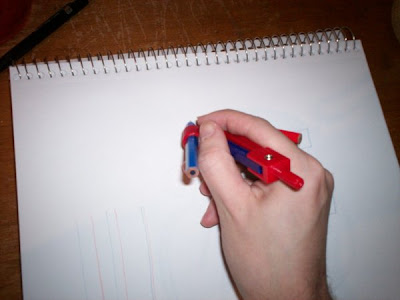
Today on my day off I was fiddling with my bike, and I swapped out my flat bars for some drops from a bike salvaged from the trash a couple months back. I did a quick ink drawing of it so I could trace it with the compass:

Here's the finished drawing. I started tracing at the rear wheel with the pencils very close together and then as I worked my way "forward" I moved the pencils farther apart. I'm not sure how well the 3D ended up working, but it still looks sort of cool:

Update: as soon as I posted this and was looking at the finished drawing again, I thought to check something. The blue pencil that came with the kit is totally the wrong color: if you hold the red lens of the glasses right against the paper then you only see the blue lines, but if you look through the blue side then both lines are clearly visible. I think actually the pencil is close to "true blue," whereas the glasses are cyan. I'll have to pick up a cyan pencil and see if I can get better results.

It's this little plastic "compass" that holds a blue and red pencil in place so you can draw with both of them at the same time at a fixed distance apart from one another. Here are the instructions from the back of the package:

And here it is in use as I draw some practice shapes:

Today on my day off I was fiddling with my bike, and I swapped out my flat bars for some drops from a bike salvaged from the trash a couple months back. I did a quick ink drawing of it so I could trace it with the compass:

Here's the finished drawing. I started tracing at the rear wheel with the pencils very close together and then as I worked my way "forward" I moved the pencils farther apart. I'm not sure how well the 3D ended up working, but it still looks sort of cool:

Update: as soon as I posted this and was looking at the finished drawing again, I thought to check something. The blue pencil that came with the kit is totally the wrong color: if you hold the red lens of the glasses right against the paper then you only see the blue lines, but if you look through the blue side then both lines are clearly visible. I think actually the pencil is close to "true blue," whereas the glasses are cyan. I'll have to pick up a cyan pencil and see if I can get better results.
Wednesday, March 19, 2008
I'm a Terrible Roommate
I often let the cat box go for days, or even more than a week, without being scooped. With two cats, that's a lot of stank.
Tuesday, March 18, 2008
AstroTurking
Last week DU told me about Amazon's "mechanical Turk" program, which is basically a framework that allows the hiring of human labor to accomplish very small tasks that are difficult for computers.
The implications are pretty awesome (in the sense of inspiring awe) and extremely creepy, and as DU pointed out its primary application right now is probably using Indian labor to game search engines and other similar sketchiness. Which is nothing new, of course; Amazon is just democratizing something you'd previously have had to contract out for.
In any case, it made me think that a good use for this would be political astroturfing. At one point in 2005 I tried to turn myself into a sort of volunteer Democratic operative on one web community. I created a pseudonymous account, and every day I would look at the DNC's latest press release and then go post a diary echoing the DNC's claims in my own words.
The intent was to help counter the constant drum of GOP talking points propagated by the Right-Wing Noise Machine. This proved essentially impossible, simply because the whole way the Might Wurlitzer works is through repetition: by the time you hear someone repeat some anti-Kerry slur reported by Wolf Blitzer as what "some leading Democrats are saying," you've already heard it from half a dozen Rush listeners, Leno viewers, workplace know-nothings and your great uncle's email list. As Digby reminds me, it's the constant reinforcement of these memes that makes them "stick."
In contrast, when I loaded up democrats.org each day, my first reaction would be "they're talking about what?" Not that their lines of attack were bad, but they just weren't being repeated anywhere: I'd listen to Air America and read a bunch of liberal blogs, and nobody would be focusing on, e.g., deforestation, or whatever the DNC was on about that day. I felt like my efforts were for naught because nothing I said had any resonance.
Anyway, all of this is a long preamble to the idea that something like the mechanical Turk program could be used for this kind of thing really easily. Like, each day have a specific idea or key phrase (say, that John McCain has a history of financial corruption, or just the word "McSame") show up posted by ten different people on each of the ten most popular political blogs or forums. At a dollar per comment that's only $100 a day. And no single comment needs to be persuasive or even really coherent, because the point is to just get it out there and resonating.
Sync these messages up to what campaign surrogates are saying in the media and I think this approach could be really effective. But even when instigated by a single lone actor it would accomplish much more than my solitary shilling ever could.
The implications are pretty awesome (in the sense of inspiring awe) and extremely creepy, and as DU pointed out its primary application right now is probably using Indian labor to game search engines and other similar sketchiness. Which is nothing new, of course; Amazon is just democratizing something you'd previously have had to contract out for.
In any case, it made me think that a good use for this would be political astroturfing. At one point in 2005 I tried to turn myself into a sort of volunteer Democratic operative on one web community. I created a pseudonymous account, and every day I would look at the DNC's latest press release and then go post a diary echoing the DNC's claims in my own words.
The intent was to help counter the constant drum of GOP talking points propagated by the Right-Wing Noise Machine. This proved essentially impossible, simply because the whole way the Might Wurlitzer works is through repetition: by the time you hear someone repeat some anti-Kerry slur reported by Wolf Blitzer as what "some leading Democrats are saying," you've already heard it from half a dozen Rush listeners, Leno viewers, workplace know-nothings and your great uncle's email list. As Digby reminds me, it's the constant reinforcement of these memes that makes them "stick."
In contrast, when I loaded up democrats.org each day, my first reaction would be "they're talking about what?" Not that their lines of attack were bad, but they just weren't being repeated anywhere: I'd listen to Air America and read a bunch of liberal blogs, and nobody would be focusing on, e.g., deforestation, or whatever the DNC was on about that day. I felt like my efforts were for naught because nothing I said had any resonance.
Anyway, all of this is a long preamble to the idea that something like the mechanical Turk program could be used for this kind of thing really easily. Like, each day have a specific idea or key phrase (say, that John McCain has a history of financial corruption, or just the word "McSame") show up posted by ten different people on each of the ten most popular political blogs or forums. At a dollar per comment that's only $100 a day. And no single comment needs to be persuasive or even really coherent, because the point is to just get it out there and resonating.
Sync these messages up to what campaign surrogates are saying in the media and I think this approach could be really effective. But even when instigated by a single lone actor it would accomplish much more than my solitary shilling ever could.
Monday, March 17, 2008
Lewis Lapham on Steroids
On the topic of steroids, that is.
Harper's is my regular gym read, and I find that a month's worth of workouts usually provides just enough time on the elliptical machine to get through one issue, more or less, depending on how well I stick to my exercise schedule and how hard the cryptic is.
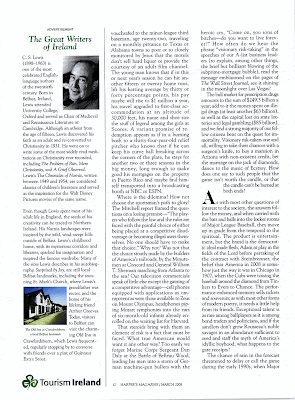
Anyway, because of a combination of my ski vacation and general laziness, I've fallen a whole two issues behind, so I just this weekend started reading the March issue, and Lewis Lapham's Notebook entry, entitled "Mudville," is an excellent satirical examination of performance-enhancing drugs in baseball and the American Dream. More or less along the lines of this blog post from a couple months back, but less scattered, more incisive, and funnier.
The text isn't up on their website, but they do have images of the scanned pages, which I've shared below.


Harper's is my regular gym read, and I find that a month's worth of workouts usually provides just enough time on the elliptical machine to get through one issue, more or less, depending on how well I stick to my exercise schedule and how hard the cryptic is.
Anyway, because of a combination of my ski vacation and general laziness, I've fallen a whole two issues behind, so I just this weekend started reading the March issue, and Lewis Lapham's Notebook entry, entitled "Mudville," is an excellent satirical examination of performance-enhancing drugs in baseball and the American Dream. More or less along the lines of this blog post from a couple months back, but less scattered, more incisive, and funnier.
The text isn't up on their website, but they do have images of the scanned pages, which I've shared below.


Friday, March 14, 2008
Monday, March 3, 2008
Earday!
After hours of study in the far reaches of internet photo sites, Sarah and I at some point determined that corgis' ears don't come out perked up...they're born with floppy ears, and at some point first one and then the other stands up. We already decided that when we get Bonkers (if he's young enough when we get him) then we'll celebrate both of his eardays.
Anyway, I happened to be looking at pics of Maddi today, and noticed that there's a good portrayal of the corgi ear progression.
Here she is at six weeks old:

At seven weeks, one ear stands up:

And after eight weeks, both ears are standing up:

Anyway, I happened to be looking at pics of Maddi today, and noticed that there's a good portrayal of the corgi ear progression.
Here she is at six weeks old:

At seven weeks, one ear stands up:

And after eight weeks, both ears are standing up:

Thursday, February 21, 2008
Happy Kitty Birthday!
Today it's my cats's birthday's! They're two years old. Judging by Lucy's behavior this morning starting about an hour before my alarm went off, they are either entering their terrible twos or their rebellious teenage years.
I made them party hats using the outline from this template, scaled down to fit a cat-head instead of a person-head. I personalized them with photos of each of them:
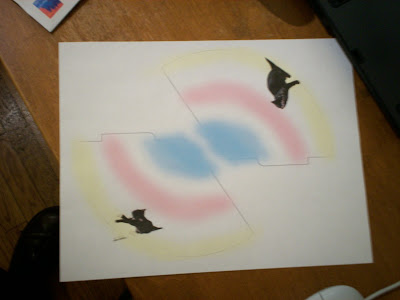
And then I added some happy birthday messages and taped them up:

I experimented with chin straps, and it just was not happening. So I had to try to get a hat near one of their heads and then snap a picture before they batted it away. The perfect ensemble portrait I had pictured in my mind was clearly an impossibility.


Happy birthday, Lucy and the Colonel! I love you guys!
I made them party hats using the outline from this template, scaled down to fit a cat-head instead of a person-head. I personalized them with photos of each of them:

And then I added some happy birthday messages and taped them up:

I experimented with chin straps, and it just was not happening. So I had to try to get a hat near one of their heads and then snap a picture before they batted it away. The perfect ensemble portrait I had pictured in my mind was clearly an impossibility.


Happy birthday, Lucy and the Colonel! I love you guys!
Zoning
Matt Yglesias discusses how zoning can work against a vibrant urban environment. I think this is one of those cases where a thinking person should be able to look at the rhetoric in support of certain policies, contrast that with the undeniable reality of their effects, and infer that the true motivations are something else. Zoning regulations have been recognized as a destructive force for decades, and the fact that they persist, and that well-connected developers continue to pocket piles of public money because of them, might suggest that the people who maintain them are perhaps not interested in urban vibrancy at all.
Not really related, but Harper's has publicly posted their article on "The next bubble." It's supposed to be a warning against buying into whatever mania takes the place of real estate, but my take-away is to invest in green technologies right now, then cash out in five years and buy a cheap-ass house. Can't fail.
Not really related, but Harper's has publicly posted their article on "The next bubble." It's supposed to be a warning against buying into whatever mania takes the place of real estate, but my take-away is to invest in green technologies right now, then cash out in five years and buy a cheap-ass house. Can't fail.
Wednesday, February 20, 2008
Monday, February 11, 2008
Non-water liquids as beverage media.
I've had this idea before that one could make a cape codder with extra cranberry flavor by starting with pure cranberry juice and diluting it to drinking strength with vodka rather than water. The resulting drink would be as flavorful as a regular cranberry juice cocktail and as alcoholic as a normal bar cocktail. You might want to add some sugar as well.
Anyway, my lover and I were recently discussing coffee brewing. She was a big proponent of brewing methods that keep the coffee hot, so that it doesn't end up being too cold after you add a lot of milk. One solution is to steam or otherwise heat up the milk before you stir it in.
I was mulling this over, so to speak, and it struck me that you could do something similar to my cape codder variation, brewing the coffee directly in hot milk (or a milk/water mixture) rather than water.
You would probably want to use a manual drip brewer or French press so you don't have to worry about getting old milk all up in a machine that's not easy to clean. Then just heat some milk up on the stove and pour it in. You could even try milk in a Moka pot.
This approach is preferable to water brewing and adding cold milk in that it doesn't cool off the final beverage. It is preferable to heating up milk separately in that it only requires one heating step. And it is preferable to either in that it does not dilute the coffee.
Anyway, my lover and I were recently discussing coffee brewing. She was a big proponent of brewing methods that keep the coffee hot, so that it doesn't end up being too cold after you add a lot of milk. One solution is to steam or otherwise heat up the milk before you stir it in.
I was mulling this over, so to speak, and it struck me that you could do something similar to my cape codder variation, brewing the coffee directly in hot milk (or a milk/water mixture) rather than water.
You would probably want to use a manual drip brewer or French press so you don't have to worry about getting old milk all up in a machine that's not easy to clean. Then just heat some milk up on the stove and pour it in. You could even try milk in a Moka pot.
This approach is preferable to water brewing and adding cold milk in that it doesn't cool off the final beverage. It is preferable to heating up milk separately in that it only requires one heating step. And it is preferable to either in that it does not dilute the coffee.
Friday, February 8, 2008
I'm a Terrible Roommate
I frequently feel the urge to vent about some supposed impropriety perpetrated by one or the other of my roommates. But I'm aware that pretty much everyone does things that will get on someone's nerves if they live together, and it has a lot less to do with what the offenses actually are than it does with their being repeated over and over and how you can't really do anything to get away from them.
So I decided that any time one of my dear roomies moves my favorite oven mitt and I'm all full of righteous anger about it, that instead of venting I'll try to put myself in their shoes. I'll think of something I do all the time, obliviously, that might plausibly drive one of them up the wall.
The point isn't too identify personal shortcomings in myself for the sake of fixing them—because really, what are the chances that I accurately stumble across one of the many potentially annoying behaviors that actually bugs one of my roommates—but merely to remind myself that living with relative strangers is always difficult and takes patience.
So with that explanation out of the way, here's the first reason I'm a Terrible Roommate: I never ask my roommates' permission, or even offer a heads-up, before inviting people over, letting friends from out of town crash on the couch, dog-sitting, or any other act of hospitality on my part that could reasonably be understood as a huge imposition on my cohabitants.
So I decided that any time one of my dear roomies moves my favorite oven mitt and I'm all full of righteous anger about it, that instead of venting I'll try to put myself in their shoes. I'll think of something I do all the time, obliviously, that might plausibly drive one of them up the wall.
The point isn't too identify personal shortcomings in myself for the sake of fixing them—because really, what are the chances that I accurately stumble across one of the many potentially annoying behaviors that actually bugs one of my roommates—but merely to remind myself that living with relative strangers is always difficult and takes patience.
So with that explanation out of the way, here's the first reason I'm a Terrible Roommate: I never ask my roommates' permission, or even offer a heads-up, before inviting people over, letting friends from out of town crash on the couch, dog-sitting, or any other act of hospitality on my part that could reasonably be understood as a huge imposition on my cohabitants.
Not sure if I screwed this up.
So I'm playing a scrabolous game with Nate. He had just played JOG hanging over the bottom triple word:

I was holding ROASTED, which I saw I could play along the left to make STAG. But if I could bingo by hooking my S onto JOG instead then it would be a 100+ point play. I couldn't find an anagram, though, so I did this:

I think it's the first time I've been holding a playable bingo and not played it. And I burned my E,R, and S. My reasoning was: it was worth almost as much as the bingo would have been (60 vs. 66, if I recall); leaving JOGS open would risk most of my bingo points anyway if Nate was holding an S; and I could land my D on the double letter and leave myself with A and T on my rack.

And Nate makes a play on a whole different triple as I draw...another bingo!

Not a very valuable or safe one, admittedly. But still pretty lucky. I think I may have not made the best choice with DOERS, but since I lucked out and didn't get punished for it at all, I'm afraid it might encourage bad habits.
Update: I ran the board past Quackle. DOATERS and TROADES are both valid. None of the AIs recommended DOERS.
Update: Also since Quackle counts tiles for you, I noted that at the time I was deciding whether to play DOERS, I was holding the fourth and final S. You'd think I would have thought to count those since blocking JOGS was a big part of my calculus. I'm an idiot.

I was holding ROASTED, which I saw I could play along the left to make STAG. But if I could bingo by hooking my S onto JOG instead then it would be a 100+ point play. I couldn't find an anagram, though, so I did this:

I think it's the first time I've been holding a playable bingo and not played it. And I burned my E,R, and S. My reasoning was: it was worth almost as much as the bingo would have been (60 vs. 66, if I recall); leaving JOGS open would risk most of my bingo points anyway if Nate was holding an S; and I could land my D on the double letter and leave myself with A and T on my rack.

And Nate makes a play on a whole different triple as I draw...another bingo!

Not a very valuable or safe one, admittedly. But still pretty lucky. I think I may have not made the best choice with DOERS, but since I lucked out and didn't get punished for it at all, I'm afraid it might encourage bad habits.
Update: I ran the board past Quackle. DOATERS and TROADES are both valid. None of the AIs recommended DOERS.
Update: Also since Quackle counts tiles for you, I noted that at the time I was deciding whether to play DOERS, I was holding the fourth and final S. You'd think I would have thought to count those since blocking JOGS was a big part of my calculus. I'm an idiot.
Thursday, February 7, 2008
3-2-1 Compact
I never fucked around with Compact Fluorescent light "bulbs" before. My thinking was that as a single non-homeowner, my lifestyle doesn't really justify buying anything that's going to last five years. But I have cats, so I guess that reasoning doesn't really hold up. And then a couple recent events caused me to take the plunge and pick up a couple.
First, Rob Cockerham posted quantifying the efficiency gains of CF over incandescent, which I found pretty persuasive. A couple days later he posted again with some negative feedback he'd received in response to his CFL essay. These responses set off my right-wing bullshit detector (my detector of right-wing bullshit, that is) right away. They all consisted of lists of the same "gotcha" objections (e.g., you can't use a CFL in your oven) without ever challenging the central assertion (that CFLs are far, far more energy efficient than incandescent bulbs).
It's exactly the style of argument used to dispute the veracity of global climate change, evolution, or the Holocaust: the point isn't to actually win the debate, but rather to make it appear to the casual observer that, first, there is a debate to be had; and second, since it seems to involve all these highly technical points regarding flagella or mercury disposal or whatnot, the layman had best just leave the whole thing alone and not pass judgment one way or the other. "Opinions Differ on Shape of Earth," as the joke goes.
Anyway, down towards the end of the response page someone gives the game away by linking to a WorldNetDaily article (duly sadlynotified later that day). So while I haven't talked to anyone who can figure out what's motivating right-wingers to go after CFLs aside from sheer misanthropic orneriness, it seems pretty clear that I'm now obligated to use CF on principle.
Oh and then when I was helping Andrew move he revealed that he had a couple in his apartment. I had been worried about the light quality of CFLs, but as an artist in the medium of light, his endorsement carries a lot of weight. So I picked up a couple and put them in both my bathrooms.
I'm pretty happy with them so far. They seemed dimmer than the 75W bulbs they replaced at first, but then when I gave them time to warm up they looked okay. Here's my downstairs bathroom, pictures taken just after flipping the lightswitch, and then every 10 seconds after:

So it's really yellow at first but pretty white by the time you're done brushing your teeth or peeing, and you can put on your makeup or artificial tan without concern.
Also the incandescents I had been using were those full spectrum or "daylight" ones, so that's part of the difference. They also have CFLs like that, but they were like twice as expensive, so I went with the regular ones.
Next up will be my bedroom, where I have three incandescents (plus two track lights that I think are halogens) right now. I have one 3-way lamp and one with a dimmer, but they have fancy CFLs on the market for both of those situations. And then my other floor lamp's socket is recessed so far that I couldn't get the ones I got to screw in, so I'll have to see if I can find one that's shaped differently.
The future is now, in any case.
First, Rob Cockerham posted quantifying the efficiency gains of CF over incandescent, which I found pretty persuasive. A couple days later he posted again with some negative feedback he'd received in response to his CFL essay. These responses set off my right-wing bullshit detector (my detector of right-wing bullshit, that is) right away. They all consisted of lists of the same "gotcha" objections (e.g., you can't use a CFL in your oven) without ever challenging the central assertion (that CFLs are far, far more energy efficient than incandescent bulbs).
It's exactly the style of argument used to dispute the veracity of global climate change, evolution, or the Holocaust: the point isn't to actually win the debate, but rather to make it appear to the casual observer that, first, there is a debate to be had; and second, since it seems to involve all these highly technical points regarding flagella or mercury disposal or whatnot, the layman had best just leave the whole thing alone and not pass judgment one way or the other. "Opinions Differ on Shape of Earth," as the joke goes.
Anyway, down towards the end of the response page someone gives the game away by linking to a WorldNetDaily article (duly sadlynotified later that day). So while I haven't talked to anyone who can figure out what's motivating right-wingers to go after CFLs aside from sheer misanthropic orneriness, it seems pretty clear that I'm now obligated to use CF on principle.
Oh and then when I was helping Andrew move he revealed that he had a couple in his apartment. I had been worried about the light quality of CFLs, but as an artist in the medium of light, his endorsement carries a lot of weight. So I picked up a couple and put them in both my bathrooms.
I'm pretty happy with them so far. They seemed dimmer than the 75W bulbs they replaced at first, but then when I gave them time to warm up they looked okay. Here's my downstairs bathroom, pictures taken just after flipping the lightswitch, and then every 10 seconds after:

So it's really yellow at first but pretty white by the time you're done brushing your teeth or peeing, and you can put on your makeup or artificial tan without concern.
Also the incandescents I had been using were those full spectrum or "daylight" ones, so that's part of the difference. They also have CFLs like that, but they were like twice as expensive, so I went with the regular ones.
Next up will be my bedroom, where I have three incandescents (plus two track lights that I think are halogens) right now. I have one 3-way lamp and one with a dimmer, but they have fancy CFLs on the market for both of those situations. And then my other floor lamp's socket is recessed so far that I couldn't get the ones I got to screw in, so I'll have to see if I can find one that's shaped differently.
The future is now, in any case.
Tuesday, February 5, 2008
Elite Opinion and Policy Versus Politics
Ezra Klein comments on the emerging elite consensus in favor of Obama, and describes how he perceives the Obama/Clinton choice:
Or as he puts it in his longer piece (nullus):
I think I basically agree. I'd elaborate that, first, policies matter, especially to non-elites; and second, politics don't seem to ever much change, despite many smart people's best efforts at various significant points throughout history (not least the election in 1992 of William Jefferson Clinton, whose triangulized policies progressives are still trying to get out from under).
My basic belief is that Obama is more progressive on foreign policy, [Clinton]'s more liberal on social policy, but he's more likely to lead towards a more progressive moment on social policy, almost in s[p]ite of his own policy shop.
Or as he puts it in his longer piece (nullus):
The promise of [Obama's] presidency is less its capacity to change our policies than its capacity to change our politics.
I think I basically agree. I'd elaborate that, first, policies matter, especially to non-elites; and second, politics don't seem to ever much change, despite many smart people's best efforts at various significant points throughout history (not least the election in 1992 of William Jefferson Clinton, whose triangulized policies progressives are still trying to get out from under).
What it do, Travis!
Since I've been playing Scrabulous on Facebook, I've always noticed, and been mildly annoyed by, the little foreign-language greetings they use to welcome you to the main screen:

For some reason it never really occurred to me that Flickr has always done the same thing:

Is this some sort of Web 2.0 standard or something? Does Ruby have a library function that returns a random international salutation?
Thinking about this also rememberized me to the fact that the school computer system in college named its individual servers this same way, each one a different word for "hello" in some other language. So when you'd telnet to cunix.cc.columbia.edu, it would actually connect you to, say, aloha.cc.columbia.edu if that had the fewest users at the time.
Anyway, so I guess it's just some geek thing thought up by dorks.

For some reason it never really occurred to me that Flickr has always done the same thing:

Is this some sort of Web 2.0 standard or something? Does Ruby have a library function that returns a random international salutation?
Thinking about this also rememberized me to the fact that the school computer system in college named its individual servers this same way, each one a different word for "hello" in some other language. So when you'd telnet to cunix.cc.columbia.edu, it would actually connect you to, say, aloha.cc.columbia.edu if that had the fewest users at the time.
Anyway, so I guess it's just some geek thing thought up by dorks.
Friday, February 1, 2008
Democratic Primareez Nutz
It seems like everyone is supporting Borat Obama now. I think he's great, and I'll gladly vote for him in the general election, but despite all the adoration people have for Obama, I'm still pretty sure I'll be pulling my lever for Hillary on Tuesday.
But I'll also be voting for her. Amanda and Ezra both linked to an essay in the Nation, that makes the argument that (roughly) the president has more leeway in setting foreign than domestic policy, so you should support the candidate with the preferable foreign policy, Obama.
I'm sympathetic to that sort of argument, since it's along the lines of my original support for Chris Dodd, but I'm ultimately unconvinced. Obama's early opposition to the Iraq war is admirable, but it came in a context (as a representative of Chicago in the Illinois State Senate) where it carried little political risk. While he has made much of that stance as public opinion on the war has soured, he has not shown the willingness to counteract the broad Democratic Party foreign policy views that let so many Democrats sign off on the war in the US Senate.
And so I would expect him to more or less follow the establishment Democratic opinion. It would be perhaps marginally more humane than Clinton's, but not the radically saner alternative that a Dodd or Kucinich could really get me excited about. Nullus.
On domestic policy, in contrast, I think Clinton is far more credible. She cut her legislative teeth tackling health care before she was even in office. She knows better than to even hint at fucking with Social Security. She will not be an echo of her husband: Bill Clinton came to the presidency with a background as a pro-business Democratic governor, while Hillary will come to it as a solid Democratic legislator with a history of support for traditional Democratic constituencies.
Recent Obama converts make a big deal about how presidents don't get carte blanche in implementing domestic policy. But they do set priorities and wield the bully pulpit. Whether they ended up succeeding (the Assault Weapons Ban, No Child Left Behind) or failing (health care reform, Social Security privatization), nobody can honestly look at the Clinton and Bush presidencies and say that the president's impact on legislation wasn't enormous.
So that's it: whoever is president will doubtlessly continue to fuck up the Middle East, Latin America, East Asia, and Africa. This is what American presidents do. Domestically, Clinton wins on both policy and politics.
Some people also argue that Obama has vision, or is a symbol of a better tomorrow, or will usher in a new era of progressivism or what have you. Whatever. JFK had all that too and he gave us Vietnam. Johnson was an unlikeable asshole who passed the Civil Rights Act and did more for social democracy than anyone since FDR. I'll take tangible results over symbolism any day.
Hillary Clenis for Nominee!
But I'll also be voting for her. Amanda and Ezra both linked to an essay in the Nation, that makes the argument that (roughly) the president has more leeway in setting foreign than domestic policy, so you should support the candidate with the preferable foreign policy, Obama.
I'm sympathetic to that sort of argument, since it's along the lines of my original support for Chris Dodd, but I'm ultimately unconvinced. Obama's early opposition to the Iraq war is admirable, but it came in a context (as a representative of Chicago in the Illinois State Senate) where it carried little political risk. While he has made much of that stance as public opinion on the war has soured, he has not shown the willingness to counteract the broad Democratic Party foreign policy views that let so many Democrats sign off on the war in the US Senate.
And so I would expect him to more or less follow the establishment Democratic opinion. It would be perhaps marginally more humane than Clinton's, but not the radically saner alternative that a Dodd or Kucinich could really get me excited about. Nullus.
On domestic policy, in contrast, I think Clinton is far more credible. She cut her legislative teeth tackling health care before she was even in office. She knows better than to even hint at fucking with Social Security. She will not be an echo of her husband: Bill Clinton came to the presidency with a background as a pro-business Democratic governor, while Hillary will come to it as a solid Democratic legislator with a history of support for traditional Democratic constituencies.
Recent Obama converts make a big deal about how presidents don't get carte blanche in implementing domestic policy. But they do set priorities and wield the bully pulpit. Whether they ended up succeeding (the Assault Weapons Ban, No Child Left Behind) or failing (health care reform, Social Security privatization), nobody can honestly look at the Clinton and Bush presidencies and say that the president's impact on legislation wasn't enormous.
So that's it: whoever is president will doubtlessly continue to fuck up the Middle East, Latin America, East Asia, and Africa. This is what American presidents do. Domestically, Clinton wins on both policy and politics.
Some people also argue that Obama has vision, or is a symbol of a better tomorrow, or will usher in a new era of progressivism or what have you. Whatever. JFK had all that too and he gave us Vietnam. Johnson was an unlikeable asshole who passed the Civil Rights Act and did more for social democracy than anyone since FDR. I'll take tangible results over symbolism any day.
Hillary Clenis for Nominee!
Biking Loses an Advantage
I hate owning a car. There are any number of annoying aspects of urban car ownership, but one of them is flyering.
Just about every week when I go to move the car for street cleaning (most weeks this is the only time I even look at my car) there is at least one advertisement tucked under the windshield wiper. Postcards and letter-sized sheets are the most popular formats, though business cards show up on occasion, and they're often filthy from enduring several nights in the open.
Yet another reason to prefer a bike, right? Well so I thought. Yesterday evening I was running errands in the city and I came back to my bike only to find that I'd been flyered:

It was an ad for some retail promotion where you get a free dinner or something. Ridiculous.
So there you go. One less advantage of cycling over driving.
And while I'm posting pictures from my cell phone, here's one of Nate with a dead salmon:

Just about every week when I go to move the car for street cleaning (most weeks this is the only time I even look at my car) there is at least one advertisement tucked under the windshield wiper. Postcards and letter-sized sheets are the most popular formats, though business cards show up on occasion, and they're often filthy from enduring several nights in the open.
Yet another reason to prefer a bike, right? Well so I thought. Yesterday evening I was running errands in the city and I came back to my bike only to find that I'd been flyered:

It was an ad for some retail promotion where you get a free dinner or something. Ridiculous.
So there you go. One less advantage of cycling over driving.
And while I'm posting pictures from my cell phone, here's one of Nate with a dead salmon:

Thursday, January 31, 2008
Meanwhile, in the world of baseball...
Since I only ever check in on baseball news every couple days, I didn't even know that Tuesday was a thrilling day to be a Mets fan. But I am excited now, anyway.
When I was first reading about who all the fans wanted to pick up for 2008, Santana really seemed like pie in the sky. Like, yes, I agreed that he would be just what the Mets needed for a contending pitching staff, but giving the Mets a contending pitching staff was not on the Twins', or any of the competing bidders', list of priorities. I dismissed it as wishful thinking and that the shot we got in 2007 was not to be repeated in the near future.
But what I don't know about the baseball business could fill a book (or at least an infrequently-updated blog), and I'm happy to be proven wrong. 2008 should be a fun year.
When I was first reading about who all the fans wanted to pick up for 2008, Santana really seemed like pie in the sky. Like, yes, I agreed that he would be just what the Mets needed for a contending pitching staff, but giving the Mets a contending pitching staff was not on the Twins', or any of the competing bidders', list of priorities. I dismissed it as wishful thinking and that the shot we got in 2007 was not to be repeated in the near future.
But what I don't know about the baseball business could fill a book (or at least an infrequently-updated blog), and I'm happy to be proven wrong. 2008 should be a fun year.
Wednesday, January 30, 2008
Civics Noob
If Joe Lieberman attends the GOP convention, then will he still be available to keynote at the Connecticut For Lieberman convention? They are running a candidate this year, right?
Warshington Noob
I came across a blog post that mentions Aplets & Cotlets. Horrible name, I know. "Cotlets." Jesus. But the blogger claims that, "growing up in Washington State, [she] always got [Aplets & Cotlets] as Christmas presents" and she hated them.
I have never heard of such a thing. The only holiday candies I associate with the Evergreen State (that's us, right?) are Almond Roca and the chocolates you get at Nordstroms's. Or possibly the Bon Marche. But they are basically less flavorful versions of fudge. I think she's from Eastern Washington, though, so maybe they do things DIFFERENT out there.
"Aplets." Christ almighty.
It looks like Turkish delight, which I don't find terrible. I do remember that it was immensely disappointing after only knowing about it from The Lion, the Witch, and the Wardrobe. Definitely not worth selling one's soul for or whatever.
I have never heard of such a thing. The only holiday candies I associate with the Evergreen State (that's us, right?) are Almond Roca and the chocolates you get at Nordstroms's. Or possibly the Bon Marche. But they are basically less flavorful versions of fudge. I think she's from Eastern Washington, though, so maybe they do things DIFFERENT out there.
"Aplets." Christ almighty.
It looks like Turkish delight, which I don't find terrible. I do remember that it was immensely disappointing after only knowing about it from The Lion, the Witch, and the Wardrobe. Definitely not worth selling one's soul for or whatever.
Monday, January 28, 2008
Home Economics Noob
I brew my tea by the cup, boiling the water in a small electric kettle. I have always overfilled it slightly, so as to avoid any risk of not being able to fill my cup adequately. Last week I switched it up, so that now I may come up short once in a while, but I'll only rarely end up with too much.
I'm not really concerned with wasted water so much, but I'm worried the energy used to heat up the water might add up over time.
I figure I probably have an average of two cups a day when weekends and days I'm not working at home are factored in. So call it 700 cups a year. If I was overshooting by 20%, or two ounces, then that's 1400oz of water each year that I've been heating to boiling from room temperature.
A BTU is the energy it takes to heat a pound of water a single degree Fahrenheit. Each year I've been heating 87.5 pounds of water a whole 140 or so degrees, for a total of 12,250 unnecessary BTU each year, or about 13 million Joules.
My kettle is rated at 1000 watts, and since it is probably close to perfectly efficient (it's small and plastic, and the heating element is fully immersed), that means I'm wasting, uh...13,000...seconds. Each year.
That's three and a half hours! At minimum wage it would buy a nice lunch for two! I'm glad I've change my ways.
I'm not really concerned with wasted water so much, but I'm worried the energy used to heat up the water might add up over time.
I figure I probably have an average of two cups a day when weekends and days I'm not working at home are factored in. So call it 700 cups a year. If I was overshooting by 20%, or two ounces, then that's 1400oz of water each year that I've been heating to boiling from room temperature.
A BTU is the energy it takes to heat a pound of water a single degree Fahrenheit. Each year I've been heating 87.5 pounds of water a whole 140 or so degrees, for a total of 12,250 unnecessary BTU each year, or about 13 million Joules.
My kettle is rated at 1000 watts, and since it is probably close to perfectly efficient (it's small and plastic, and the heating element is fully immersed), that means I'm wasting, uh...13,000...seconds. Each year.
That's three and a half hours! At minimum wage it would buy a nice lunch for two! I'm glad I've change my ways.
Tuesday, January 22, 2008
Comics Nooby
I took a sketch pad and my new brush pen home with me over the holidays, hoping to get in some good practice time. I wanted to both practice laying out full comic pages as in my baseball drawing, and to get a little more comfortable with the brush pen.
The second day I was home, I drew a couple panels portraying part of the previous day, when my mom took Nate and I on a walk down to the creek to see where the salmon were all dying after spawning:

It was a nice little vignette, I thought, so I decided that each day I would do a full page depicting something I'd done the previous day. I was laying out the panels, drawing in blue pencil, and then inking only with the brush pen.
Unfortunately, because of how vacations tend to go, most of the rest of my days were not nearly so exciting, and rather than drawing little episodes, I tended to just summarize each day with a bunch of confusingly juxtaposed panels. So the result is neither coherent nor really very interesting.
Also, the first page gave me practice drawing from different sources: the establishing landscape panel I drew from real life, then the second panel was from memory, and I used a reference photo for the third. Later pages tended to be almost all from memory. Here they are:


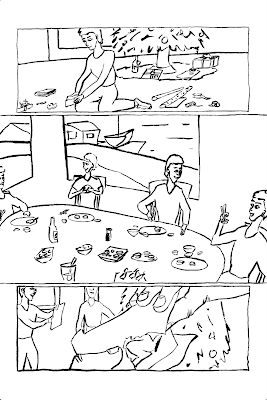


I also noticed that while I didn't have any trouble coming up with different facial features for made up characters in Night-Wight, I have no clue how to look at an actual person's face and distill their features into a drawing. So everyone looks exactly the same in these drawings, and going back I probably couldn't even tell you who is supposed to be who.
Was this exercise a success? I don't know. I didn't even really do any shading after the first three, so I don't know that I actually got any better with the brush pen. But I did come up with a good variety of panel layouts that I think mostly worked pretty well, and I know that I need to work on looking at faces and figuring out how to portray them (or rather, how to model them in my mind so that I render them as accurate portrayals). It was fun, too, so I'm glad I decided to do it.
The second day I was home, I drew a couple panels portraying part of the previous day, when my mom took Nate and I on a walk down to the creek to see where the salmon were all dying after spawning:

It was a nice little vignette, I thought, so I decided that each day I would do a full page depicting something I'd done the previous day. I was laying out the panels, drawing in blue pencil, and then inking only with the brush pen.
Unfortunately, because of how vacations tend to go, most of the rest of my days were not nearly so exciting, and rather than drawing little episodes, I tended to just summarize each day with a bunch of confusingly juxtaposed panels. So the result is neither coherent nor really very interesting.
Also, the first page gave me practice drawing from different sources: the establishing landscape panel I drew from real life, then the second panel was from memory, and I used a reference photo for the third. Later pages tended to be almost all from memory. Here they are:


I also noticed that while I didn't have any trouble coming up with different facial features for made up characters in Night-Wight, I have no clue how to look at an actual person's face and distill their features into a drawing. So everyone looks exactly the same in these drawings, and going back I probably couldn't even tell you who is supposed to be who.
Was this exercise a success? I don't know. I didn't even really do any shading after the first three, so I don't know that I actually got any better with the brush pen. But I did come up with a good variety of panel layouts that I think mostly worked pretty well, and I know that I need to work on looking at faces and figuring out how to portray them (or rather, how to model them in my mind so that I render them as accurate portrayals). It was fun, too, so I'm glad I decided to do it.
Noob of All Trades
I have non-baseball stuff I want to post. While there's no technical barrier to creating a "*n00b" blog for each of my new enthusiasms as they come up, I don't want to mess with my technorate scores and affect my ad rates.
So I've decided instead to embroaden the scope of this here blog to include any topic on which I am a clueless nooby. Which for the time being is probably going to be stuff related to Scrabble or comics or bikes or whatnot, and who knows what all else in the future!
For example, here's some crap I made for playing Scrabble, both PDF files: a score sheet, and a 2- and 3-letter word cheat sheet (from the SOWPODS word list). There are two per page, and they line up if you want to do a score sheet on one side and the cheat sheet on the other.
The score sheet is designed for two player games where each player records their rack for each move, folding the edge of the paper over to obscure the rack columns. That way you have a full record of a game played in real life, and can record it later in something like Quackle and have it tell you all the 100+ point bingos your stupid ass missed. It's great!
So I've decided instead to embroaden the scope of this here blog to include any topic on which I am a clueless nooby. Which for the time being is probably going to be stuff related to Scrabble or comics or bikes or whatnot, and who knows what all else in the future!
For example, here's some crap I made for playing Scrabble, both PDF files: a score sheet, and a 2- and 3-letter word cheat sheet (from the SOWPODS word list). There are two per page, and they line up if you want to do a score sheet on one side and the cheat sheet on the other.
The score sheet is designed for two player games where each player records their rack for each move, folding the edge of the paper over to obscure the rack columns. That way you have a full record of a game played in real life, and can record it later in something like Quackle and have it tell you all the 100+ point bingos your stupid ass missed. It's great!
Saturday, December 15, 2007
Capitalism 101: Fuck the Yankees
Putting together dominant teams by luring in the best performing players with enormous salaries creates an incentive for players to enhance their performance through any means necessary? No shit?
I'm mystified by all the Sturm und Drang surrounding the impact, e.g., Roger Clemens' steroid use will have on "the kids," who are getting the message that it's okay to abase oneself
and risk one's physical health in pursuit of material reward. Yes, using steroids to improve your athletic performance is risky to your health and career prospects. You know what else is? Trying to make a living playing professional baseball.
In terms of eventual outcome, the aspiring pro ballplayer is probably better off washing out sometime early in college, hopefully not by an injury with a severe impact on quality of life. That way you've got your fond memories of high school stardom to look back on, you've got a couple years left to decide on something to study for real, you probably know a couple people who have a shot at the Show (valuable contacts regardless of your own personal future), and you're not staring at the prospect of toiling for years in the minors and never breaking out. True, you'll always wonder what coulda been; but realistically, it probably wouldna.
It's just another example of the US schizophrenia regarding economics and consumerism. Up to a certain point, the quest for material comforts at any cost is the very lifeblood of our nation. Past that, it's a dehumanizing corruption of all that is decent. It comes up in the eternal debates over whether rap music is a positive or negative force in our society (answer: rap music is our society).
"The kids" get the message: everyone's for sale, and your primary goal in life should be to make sure you get a good price when the time comes to sell out. Revelations like the Mitchell Report simply make explicit the tacit implications of our social order. It's no wonder they're so unsettling.
I'm mystified by all the Sturm und Drang surrounding the impact, e.g., Roger Clemens' steroid use will have on "the kids," who are getting the message that it's okay to abase oneself
and risk one's physical health in pursuit of material reward. Yes, using steroids to improve your athletic performance is risky to your health and career prospects. You know what else is? Trying to make a living playing professional baseball.
In terms of eventual outcome, the aspiring pro ballplayer is probably better off washing out sometime early in college, hopefully not by an injury with a severe impact on quality of life. That way you've got your fond memories of high school stardom to look back on, you've got a couple years left to decide on something to study for real, you probably know a couple people who have a shot at the Show (valuable contacts regardless of your own personal future), and you're not staring at the prospect of toiling for years in the minors and never breaking out. True, you'll always wonder what coulda been; but realistically, it probably wouldna.
It's just another example of the US schizophrenia regarding economics and consumerism. Up to a certain point, the quest for material comforts at any cost is the very lifeblood of our nation. Past that, it's a dehumanizing corruption of all that is decent. It comes up in the eternal debates over whether rap music is a positive or negative force in our society (answer: rap music is our society).
"The kids" get the message: everyone's for sale, and your primary goal in life should be to make sure you get a good price when the time comes to sell out. Revelations like the Mitchell Report simply make explicit the tacit implications of our social order. It's no wonder they're so unsettling.
Wednesday, December 5, 2007
I had no idea.
I was out on my lunch break and stopped by the little tea shop by my house to pick up some key staples (while passing on some others that they also carry). The radio was on in the shop, but since it is my habit to tune out radio broadcasts of anything other than rap music, I wasn't listening to it. Then as the owner was ringing me up he commented that he was hoping listening to talk about baseball would warm him up.
Baseball! They were talking about baseball on the radio! It's the middle of winter! But of course, this is what's known as the "off season," when all sorts of trades happen. So I came right home and checked to see if my beloved Mets were up to anything. And they traded Lastings Milledge!
Reading some of the discussion, a lot of people seem to be concerned with the race angle. I think the notion that the owners or management want a completely non-black team is pretty far-fetched, but I do think it would be worth enduring insults from the slavering racists at the Post (seriously, when did it become common knowledge that Don Imus recorded the first rap record?) to have a shot at bringing up a homegrown African-American superstar.
The small number of blacks in baseball means that the ones who become great have that much more star power. The Mets would have done well to stick with Milledge and try to benefit from that potential, better representing the city and broadening the fan base as they have done with Latino players.
Anyway. Did not expect to be thinking about baseball other than in video games or drawings for several more months. But there you go.
Baseball! They were talking about baseball on the radio! It's the middle of winter! But of course, this is what's known as the "off season," when all sorts of trades happen. So I came right home and checked to see if my beloved Mets were up to anything. And they traded Lastings Milledge!
Reading some of the discussion, a lot of people seem to be concerned with the race angle. I think the notion that the owners or management want a completely non-black team is pretty far-fetched, but I do think it would be worth enduring insults from the slavering racists at the Post (seriously, when did it become common knowledge that Don Imus recorded the first rap record?) to have a shot at bringing up a homegrown African-American superstar.
The small number of blacks in baseball means that the ones who become great have that much more star power. The Mets would have done well to stick with Milledge and try to benefit from that potential, better representing the city and broadening the fan base as they have done with Latino players.
Anyway. Did not expect to be thinking about baseball other than in video games or drawings for several more months. But there you go.
Sunday, December 2, 2007
Katie Casey was baseball mad
I finally got around to going by Peter's place to watch the third disc of Ken Burns' Baseball. This was a good one...I think we each only started nodding off once or twice. It started with Ty Cobb, continued on through World War I, and then wrapped up with the Black Sox. Pretty fascinating stuff.
After it was over, we looked up the full lyrics to "Take Me Out to the Ball Game," sang a few rounds, and then played the trivia game that's part of the special features of each DVD. For the first time so far, we batted a perfect 1.000! I think we only had to guess on like one question.
After it was over, we looked up the full lyrics to "Take Me Out to the Ball Game," sang a few rounds, and then played the trivia game that's part of the special features of each DVD. For the first time so far, we batted a perfect 1.000! I think we only had to guess on like one question.
Thursday, November 29, 2007
Drawing
I got some new pens and paper the other day. The paper is just a cheap sketch pad, but at 11" x 14" it's big enough to draw a comic-sized page with bleed at 125% real size. I almost went for the 14" x 17", which would let me draw at 150% real size, but I don't really have the desk space to even use that, so I decided not to bother.
The pens include the Japanese Pentel brush pen that everyone loves. It's fun, but it does put down a ton of ink and I'm still pretty shaky with it. The bristles are really infinitely better than the crappy felt-tipped "brush" pen I was using before. I also got some smaller sizes of the regular Pigma pens, and then I stole a Sharpie from work.

I just wanted to block out and draw a full page on one sheet, and I think Peter inspired me to do a little baseball scene. I'm not working on a longer baseball story or anything: I just wanted to try out the format, and a squeeze play seemed like something I could portray on a single page that would cohere in the absence of a larger narrative context while also giving me a couple interesting backgrounds and figures to draw from a few different angles and positions (nh).
I'm not sure the three bottom panels really make sense the way they're drawn. It might work with color (panels brighter than the background?), or it might be something I'd have to do over.
Update: Those last three panels kept bugging me, so I went back and fixed them. I cut a piece of the same sketch book paper down to fit in my printer, blew the image back up to 125%, and just printed out the bottom part, landscape mode, in very light cyan. I only reinked the panel borders and the parts inside the old panels, then scanned it back in, lined up the new layer, and erased the unneeded lines.

I should have done this as a new post, rather than an update, just so I could title it "Back to the Old Drawing Board...Literally!" Oh well. I just noticed that I left the catcher as bare line art, and it looks kind of out of place. I'm not planning on fixing that, but if I do then I guess I have a title for the blog post.
The pens include the Japanese Pentel brush pen that everyone loves. It's fun, but it does put down a ton of ink and I'm still pretty shaky with it. The bristles are really infinitely better than the crappy felt-tipped "brush" pen I was using before. I also got some smaller sizes of the regular Pigma pens, and then I stole a Sharpie from work.

I just wanted to block out and draw a full page on one sheet, and I think Peter inspired me to do a little baseball scene. I'm not working on a longer baseball story or anything: I just wanted to try out the format, and a squeeze play seemed like something I could portray on a single page that would cohere in the absence of a larger narrative context while also giving me a couple interesting backgrounds and figures to draw from a few different angles and positions (nh).
I'm not sure the three bottom panels really make sense the way they're drawn. It might work with color (panels brighter than the background?), or it might be something I'd have to do over.
Update: Those last three panels kept bugging me, so I went back and fixed them. I cut a piece of the same sketch book paper down to fit in my printer, blew the image back up to 125%, and just printed out the bottom part, landscape mode, in very light cyan. I only reinked the panel borders and the parts inside the old panels, then scanned it back in, lined up the new layer, and erased the unneeded lines.

I should have done this as a new post, rather than an update, just so I could title it "Back to the Old Drawing Board...Literally!" Oh well. I just noticed that I left the catcher as bare line art, and it looks kind of out of place. I'm not planning on fixing that, but if I do then I guess I have a title for the blog post.
Monday, November 19, 2007
Whee, baseball!
After brunch yesterday, a couple of my usual cronies went by to play with Gabe's Wii (nullus). Peter immediately noticed that the sports game had a baseball mode or level or whatever.
Andrew: Oh, Baseball's really boring.
Me: I know baseball's boring. That's why I like it.
Needless to say, Peter and I played at the first opportunity. He took an early lead with a single-run homer in the bottom of the first. I tied it up in the next inning and left a man stranded, but then fanned three batters to end the inning. I went scoreless in the third, and then Peter stepped up and won the game with a two-run walk-off home run. Pretty dramatic! I believe I hit for .222 and struck out five or six batters.
One funny thing was that Peter was striking me out throwing the same outside breaking balls that earned him so many K's in the wiffleball park.
I was also no good at Boxing. Video games!
Andrew: Oh, Baseball's really boring.
Me: I know baseball's boring. That's why I like it.
Needless to say, Peter and I played at the first opportunity. He took an early lead with a single-run homer in the bottom of the first. I tied it up in the next inning and left a man stranded, but then fanned three batters to end the inning. I went scoreless in the third, and then Peter stepped up and won the game with a two-run walk-off home run. Pretty dramatic! I believe I hit for .222 and struck out five or six batters.
One funny thing was that Peter was striking me out throwing the same outside breaking balls that earned him so many K's in the wiffleball park.
I was also no good at Boxing. Video games!
Thursday, November 8, 2007
More Baseball, and other stuff
Peter came over on Tuesday night with the second disc of Ken Burns' Baseball and we enjoyed it alongside some beers and Middle Eastern food. The further hijinx of tremendous asshole John McGraw—on the one hand carrying a piece from a noose used in a lynching for good luck, on the other (?) hand trying to sneak a black player onto his team by calling him "Chief John Tokohama," supposedly an Indian—were of course entertaining, but the highlight for me were the clips from a DeWolf Hopper recitation of "Casey at the Bat," a poem whose charms have always eluded me.
The pictures in the Wikipedia entry show him as a young man, and it says he was only thirty when he first performed the poem. But given that that was well before the turn of the century, I suppose it isn't surprising that by the time the film used in the documentary was recorded, he was pretty creepily ancient. I wish I could find a YouTube of it, but his lipstick alone is spine-tingling, and that's before he even begins his Cryptkeeperly melodramatic delivery. Ugh. I can't tell if the repulsiveness of the performance indicates the wide gulf between what was then and what is now considered entertaining, or if rather it suggests an element of the freak show in vaudeville that modern audiences only look for in reality television.
Hm, Wikipedia also says Hopper had (at least, I suppose) six wives. Interesting that as I watched the clip, some of my thoughts were along the lines as "so sad that this is what gays once had to resort to to make a living."
On the topic of oldish film clips (and gays, and tremendous assholes), a blog discussion of a debate on 9/11 conspiracy theories led me to discover clips from one of a series of debates between William Buckley and Gore Vidal during the 1968 presidential election. So many awesome things about these.
First, I love the rhetoric. Buckley's intimations of treason are of course not so different from what we hear from the bloodthirsty right today, with standard issue red-baiting standing in for contemporary accusations of Saddam-loving and terrorist-loving. But Vidal's side, damn. I realize that this one debate, taking place as it did during the unrest of the Chicago Democratic Convention, is unique even for the time, but the idea that the whole issue of the debate is framed from the beginning as essentially "yes or no: we are now living in an authoritarian police state" speaks volumes. Coming from a world in which Russ Feingold's is a champion of the left for quietly opining that perhaps millionaires should not be able to buy their way into political office, it's refreshing (and depressing) to see that national television once made room for a genuinely left-wing point of view. Vidal is still around, but he's so old
Second, there is the part where the two "nearly come to blows," as it seems to always be described. It is basically just Gore Vidal calling William Buckley a "crypto-Nazi" and then Buckley calling Vidal a "queah" and threatening to punch him, but it is awesome. Again, you have to love the willingness to casually accuse someone of harboring fascist tendencies. Try to get a public intellectual (do such beasts still roam the world?) to apply the f-word today to even such a worthy target as, say, Rudy Giuliani. Here's the episode from YouTube:
Finally, it's fascinating to hear conservative cant from a source other than a faux cowboy jes' talkin' common sense. This predates the conservative movement's rebranding as an ideology of the working man. It's the same apologetics for the rich and powerful, but actually voiced by someone who is unabashedly rich and powerful. Which should be the most straightforward thing in the world, but because of how successful the right wing has been in burying the realities of the movement, it comes across almost as a put-on. Clearly this upper-class twit cannot really be a Nixon supporter.
Also while looking for those videos, I found a two-part debate from 1969, between Buckley and Noam Chomsky. The subject was US imperialism and interventionism, and how the two might be distinguished, if indeed they can be. Again, you have to love Buckley's shameless effete upper-classness. Chomsky comes across, appropriately enough, as a real professor type just trying to get down to the hard facts of the matter, in stark contrast with Buckley's high-flown rhetoric. It's in two parts:
The old-fashioned days, guys. So awesome.
The pictures in the Wikipedia entry show him as a young man, and it says he was only thirty when he first performed the poem. But given that that was well before the turn of the century, I suppose it isn't surprising that by the time the film used in the documentary was recorded, he was pretty creepily ancient. I wish I could find a YouTube of it, but his lipstick alone is spine-tingling, and that's before he even begins his Cryptkeeperly melodramatic delivery. Ugh. I can't tell if the repulsiveness of the performance indicates the wide gulf between what was then and what is now considered entertaining, or if rather it suggests an element of the freak show in vaudeville that modern audiences only look for in reality television.
Hm, Wikipedia also says Hopper had (at least, I suppose) six wives. Interesting that as I watched the clip, some of my thoughts were along the lines as "so sad that this is what gays once had to resort to to make a living."
On the topic of oldish film clips (and gays, and tremendous assholes), a blog discussion of a debate on 9/11 conspiracy theories led me to discover clips from one of a series of debates between William Buckley and Gore Vidal during the 1968 presidential election. So many awesome things about these.
First, I love the rhetoric. Buckley's intimations of treason are of course not so different from what we hear from the bloodthirsty right today, with standard issue red-baiting standing in for contemporary accusations of Saddam-loving and terrorist-loving. But Vidal's side, damn. I realize that this one debate, taking place as it did during the unrest of the Chicago Democratic Convention, is unique even for the time, but the idea that the whole issue of the debate is framed from the beginning as essentially "yes or no: we are now living in an authoritarian police state" speaks volumes. Coming from a world in which Russ Feingold's is a champion of the left for quietly opining that perhaps millionaires should not be able to buy their way into political office, it's refreshing (and depressing) to see that national television once made room for a genuinely left-wing point of view. Vidal is still around, but he's so old
Second, there is the part where the two "nearly come to blows," as it seems to always be described. It is basically just Gore Vidal calling William Buckley a "crypto-Nazi" and then Buckley calling Vidal a "queah" and threatening to punch him, but it is awesome. Again, you have to love the willingness to casually accuse someone of harboring fascist tendencies. Try to get a public intellectual (do such beasts still roam the world?) to apply the f-word today to even such a worthy target as, say, Rudy Giuliani. Here's the episode from YouTube:
Finally, it's fascinating to hear conservative cant from a source other than a faux cowboy jes' talkin' common sense. This predates the conservative movement's rebranding as an ideology of the working man. It's the same apologetics for the rich and powerful, but actually voiced by someone who is unabashedly rich and powerful. Which should be the most straightforward thing in the world, but because of how successful the right wing has been in burying the realities of the movement, it comes across almost as a put-on. Clearly this upper-class twit cannot really be a Nixon supporter.
Also while looking for those videos, I found a two-part debate from 1969, between Buckley and Noam Chomsky. The subject was US imperialism and interventionism, and how the two might be distinguished, if indeed they can be. Again, you have to love Buckley's shameless effete upper-classness. Chomsky comes across, appropriately enough, as a real professor type just trying to get down to the hard facts of the matter, in stark contrast with Buckley's high-flown rhetoric. It's in two parts:
The old-fashioned days, guys. So awesome.
Subscribe to:
Posts (Atom)